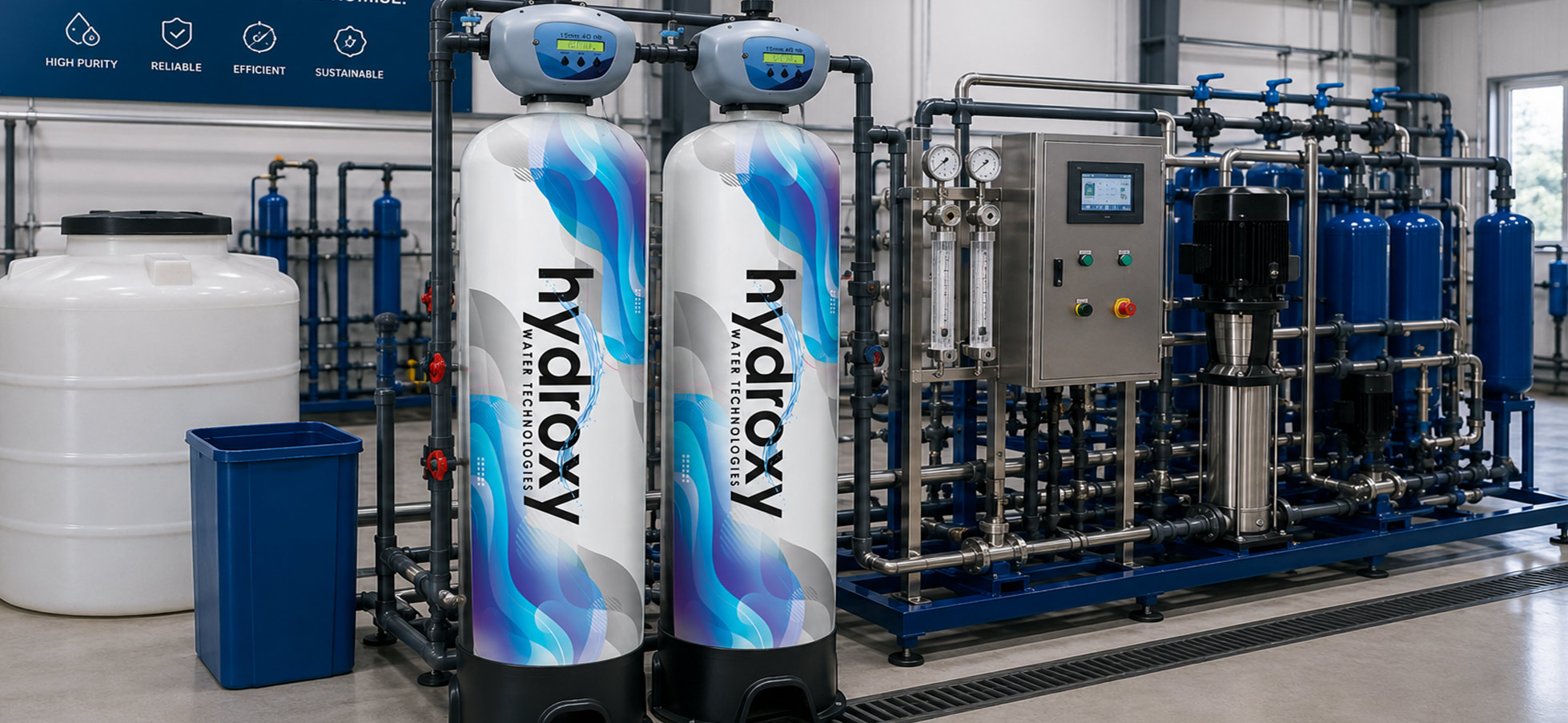
Demineralisation (DM) Plants
Hydroxy designs Demineralisation Plants to remove dissolved ionic minerals from water—producing low-conductivity, high-purity water for industrial, process and utility applications.
Demineralisation Plants
Demineralisation is an ion-exchange water purification process designed to remove dissolved positively and negatively charged mineral ions from water.
Dissolved salts can contribute ions such as calcium, magnesium, sodium, chlorides, sulphates, bicarbonates and nitrates. For applications requiring high-purity water, these dissolved minerals must be removed rather than simply filtered.
Hydroxy Water Technologies designs DM Plants around feed-water chemistry, ionic load, required treated-water conductivity, silica requirement, operating capacity and regeneration frequency.
The result is a controlled ion-exchange process engineered to deliver consistently demineralised water with reliable operating performance.

Demineralisation Principle
A conventional DM process uses specially selected ion-exchange resins to remove dissolved ionic contaminants.
Feed water first passes through a cation-exchange resin, which removes positively charged ions such as:
- Calcium
- Magnesium
- Sodium
- Other Dissolved Cations
These ions are exchanged primarily with hydrogen ions.
The water then passes through an anion-exchange resin, which removes negatively charged ions such as:
- Chlorides
- Sulphates
- Bicarbonates
- Nitrates
- Other Dissolved Anions
These ions are exchanged primarily with hydroxide ions.
Hydrogen and hydroxide ions combine to form water, leaving the treated stream with substantially reduced dissolved ionic content. Feed Water → Cation Exchange → Anion Exchange → Demineralised Water
Engineered Around Your Ionic Load - DM Plant Capacity Is More Than Litres Per Hour
The operating capacity of ion-exchange resin depends on the quantity and type of dissolved ions entering the system. Hydroxy evaluates important parameters including:
- Feed-Water Conductivity
- Total Dissolved Solids
- Total Hardness
- Calcium & Magnesium
- Sodium
- Chlorides
- Sulphates
- Alkalinity
- Silica
- pH
- Required Product-Water Conductivity
- Required Flow Rate
- Daily Water Demand
- Regeneration Frequency
These parameters determine the appropriate resin quantity, vessel capacity, treatment sequence and regeneration requirement. The objective is to size the DM Plant around the actual ionic load—not simply the required flow rate.
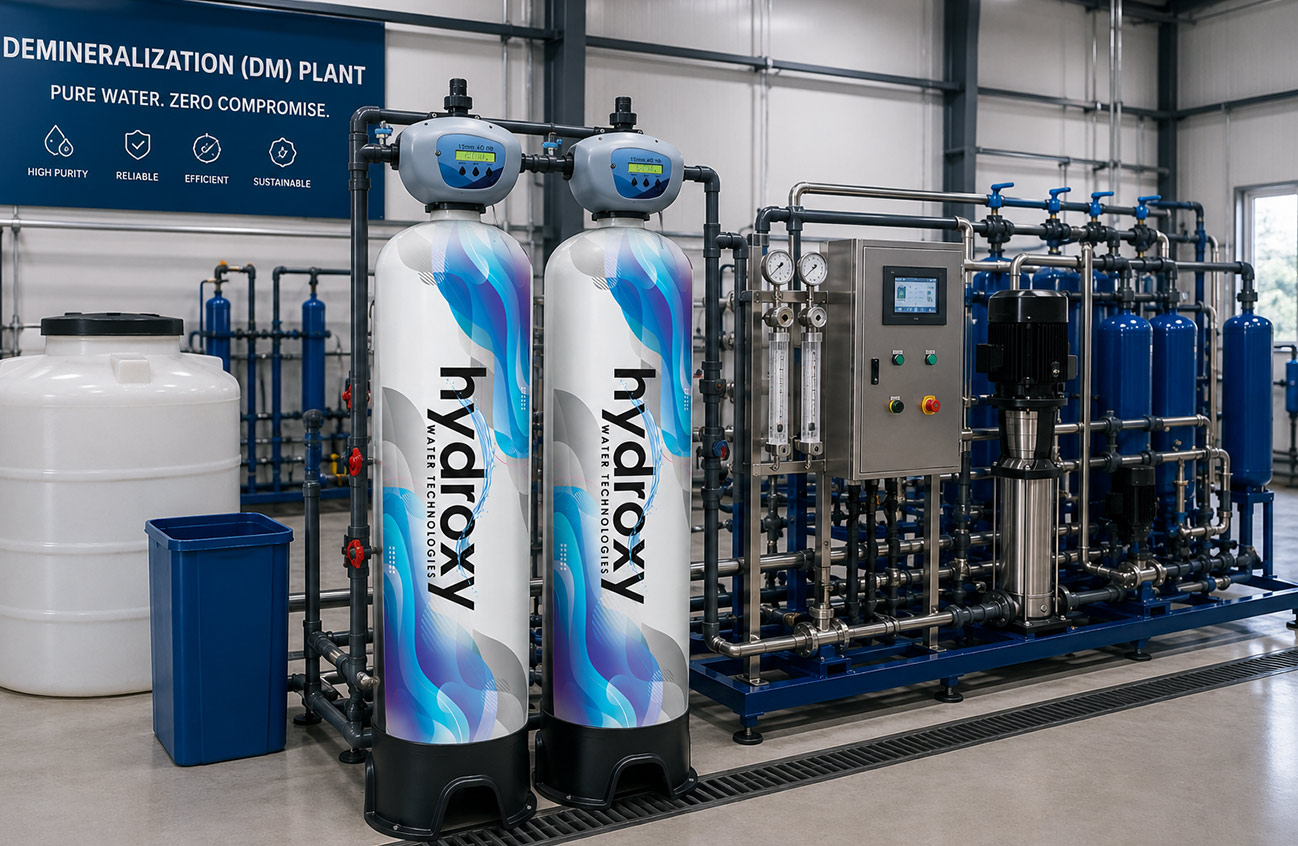
DM Plant Configuration
Depending on the required product-water quality, Hydroxy can engineer configurations such as:
A separate cation exchanger and anion exchanger provide the primary demineralisation process.
Cation and anion resins operate together within a mixed-bed vessel to provide additional polishing where lower conductivity and higher-purity water are required.
Valves, regeneration sequences and operating cycles can be integrated with automation to reduce routine manual intervention. The final configuration is selected according to feed-water chemistry and required treated-water specification.
How It Works - From Mineral-Bearing Water to Demineralised Water
Feed-water chemistry and ionic loading are evaluated.
Positively charged mineral ions are removed through cation-exchange resin.
Negatively charged ions are removed through anion-exchange resin.
Where higher-purity water is required, a mixed-bed polishing stage can be incorporated.
Conductivity and other relevant parameters are monitored to verify treated-water quality.
Once the resin reaches its operating capacity, it is chemically regenerated to restore its ion-exchange capability. Service → Exhaustion → Regeneration → Rinse → Return to Service
Resin Regeneration
Ion-exchange resin has a finite operating capacity. As dissolved ions accumulate on the resin, its ability to continue removing minerals gradually decreases. Periodic regeneration restores the resin for another service cycle. A DM regeneration sequence typically includes:
- Backwashing
- Regenerant Introduction
- Chemical Contact
- Displacement
- Rinsing
- Return to Service
Correct regeneration is essential for maintaining resin performance, treated-water quality and efficient chemical utilisation. Hydroxy designs the regeneration arrangement around the resin quantity, ionic load and plant operating requirements.
Typical Applications
Hydroxy Iron Removal Systems can be used for:
- Borewell Water
- Groundwater
- Residential Water Supply
- Apartments & Villas
- Hotels & Resorts
- Hospitals & Institutions
- Commercial Buildings
- Industrial Utility Water
- Process-Water Pre-Treatment
Typical Applications
Hydroxy DM Plants are suitable for applications requiring low-mineral or high-purity water, including:
- Boiler Feed Water
- Steam Generation
- Industrial Process Water
- Power & Utility Applications
- Pharmaceutical Process Utilities
- Chemical Processing
- Electronics & Precision Manufacturing
- Laboratory & Technical Applications
- High-Purity Water Requirements
Monitoring & Automation
Depending on the system configuration, Hydroxy DM Plants can incorporate:
- Conductivity Monitoring
- Flow Monitoring
- Pressure Monitoring
- Tank-Level Controls
- Automatic Valve Sequencing
- Regeneration Controls
- Chemical Dosing / Regeneration Controls
- PLC-Based Automation
- Alarm & System Status Monitoring
Automation can coordinate service and regeneration cycles while providing operators with better visibility into plant performance.
Why Hydroxy? - High-Purity Water Begins With Understanding the Ions
A DM Plant is not simply a pair of resin-filled vessels. Reliable demineralisation depends on the relationship between: Feed-Water Chemistry + Ionic Load + Resin Capacity + Regeneration + Required Water Purity
Incorrect resin sizing can result in frequent regeneration, excessive chemical consumption and inconsistent treated-water quality. Hydroxy designs DM Plants around the actual feed-water ionic profile and required product-water specification, providing a balanced approach to purity, operating capacity and regeneration efficiency.
Our engineering process starts with one important question: "What dissolved ions must be removed to achieve your required water purity?"
Key Benifits
Ion-exchange treatment removes dissolved ionic minerals to produce water suitable for demanding industrial and process applications.
Properly designed DM treatment significantly reduces ionic conductivity in the treated water.
Cation and anion exchange removes a broad range of positively and negatively charged dissolved minerals.
Two-bed and mixed-bed configurations can be selected according to the required final water specification.
DM resins can be chemically regenerated and returned to service through controlled operating cycles.
Systems can incorporate automated valves, regeneration sequencing and water-quality monitoring for easier operation.
Hydroxy sizes the resin quantity, vessels and regeneration cycle according to feed-water chemistry, required capacity and treated-water specification.
Pressure filtration removes suspended particles. Water softening primarily targets hardness ions. Demineralisation removes dissolved ionic minerals from the water through ion exchange to achieve substantially higher water purity.
That distinction is fundamental when selecting a treatment system for high-purity applications. Oxidation first. Filtration second. Reliable iron removal follows.