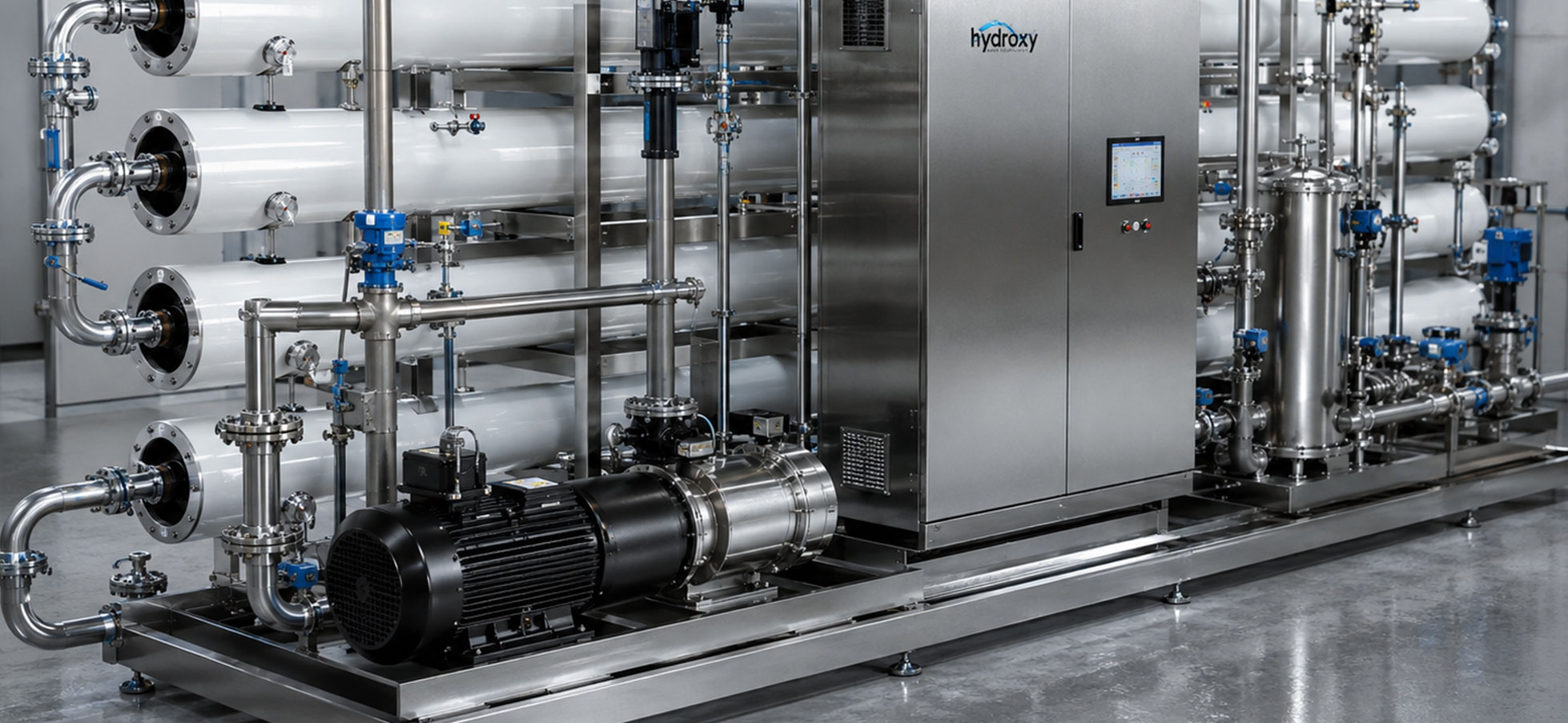
Closed Circuit Reverse Osmosis (CCRO)
Hydroxy delivers advanced Closed Circuit Reverse Osmosis solutions designed to improve water recovery, reduce concentrate generation and adapt intelligently to changing feed-water conditions—providing efficient membrane treatment for demanding commercial and industrial applications.
Closed Circuit Reverse Osmosis (CCRO)
Closed Circuit Reverse Osmosis is an advanced RO process designed to achieve high water recovery while providing greater operational flexibility than conventional fixed multi-stage RO configurations.
Unlike conventional RO systems that continuously discharge concentrate, CCRO operates using a closed-loop recirculation process. During closed-circuit operation, concentrate is circulated through the membrane system while permeate is continuously produced. Once predefined operating conditions are reached, the concentrated solution is flushed from the system and a new treatment cycle begins.
This cyclic operating approach allows recovery to be controlled through operating time and system set-points, enabling the system to respond more flexibly to variations in feed-water quality and treatment requirements.
Hydroxy integrates CCRO-based membrane treatment solutions around feed-water chemistry, product-water requirements, capacity, recovery objectives and operating conditions—creating systems designed for water efficiency, consistent performance and dependable long-term operation.

Smarter Water Recovery for High-Demand Facilities
Commercial and institutional facilities increasingly need to reduce water consumption while maintaining dependable treated-water quality.
CCRO can provide a high-recovery membrane treatment approach for facilities where reducing reject water, improving water utilisation and maintaining flexibility under changing feed conditions are important operating objectives.
- Hotels & Resorts
- Hospitals & Healthcare Facilities
- Large Commercial Campuses
- Institutional Facilities
- Central Utility Systems
- High-Demand Water Treatment Applications
High-Recovery Water Treatment for Demanding Operations
Industrial facilities often require large volumes of treated water while simultaneously managing water availability, wastewater generation and operating costs.
Hydroxy engineers CCRO solutions around feed-water chemistry, required product-water quality, recovery targets and plant operating requirements to help maximise usable water while maintaining membrane-system reliability.
- Process Water
- Boiler Feed Water
- Cooling Tower Make-Up
- Manufacturing Facilities
- Food & Beverage Processing
- Wastewater Reuse
- Brackish Water Treatment
- Industrial Utility Water
High-recovery membrane treatment is not achieved simply by adding more RO membrane stages.
As recovery increases, dissolved salts and other constituents become progressively concentrated. This makes feed-water chemistry, scaling potential, membrane selection, hydraulic conditions and operating control increasingly important.
CCRO addresses this challenge by recirculating concentrate through a closed loop and periodically flushing the concentrated volume rather than permanently exposing downstream membrane stages to the highest concentration conditions.
Hydroxy evaluates important design parameters such as:
- Total Dissolved Solids(TDS) & Hardness
- Alkalinity, Silica, Sulphates, Chlorides
- pH, Iron & Manganese, Turbidity, Organic Loading
- Scaling Potential
- Required Product-Water Quality
- Target Water Recovery
- Feed-Water Temperature
- Plant Capacity & Operating Hours
Depending on the application, a CCRO solution may incorporate:
- Activated Carbon Filtration
- Ultrafiltration
- Water Softening
- Micron Cartridge Filtration
- Antiscalant / Chemical Dosing
- High-Pressure Feed Pump
- Closed-Circuit RO Membrane Array
- Concentrate Recirculation
- Automated Concentrate Flush
- Conductivity Monitoring
- Flow & Pressure Monitoring
- Automated Process Controls
- Cleaning-in-Place provisions
*The result is a high-recovery membrane system engineered around your actual feed-water chemistry, recovery objective and operating environment.
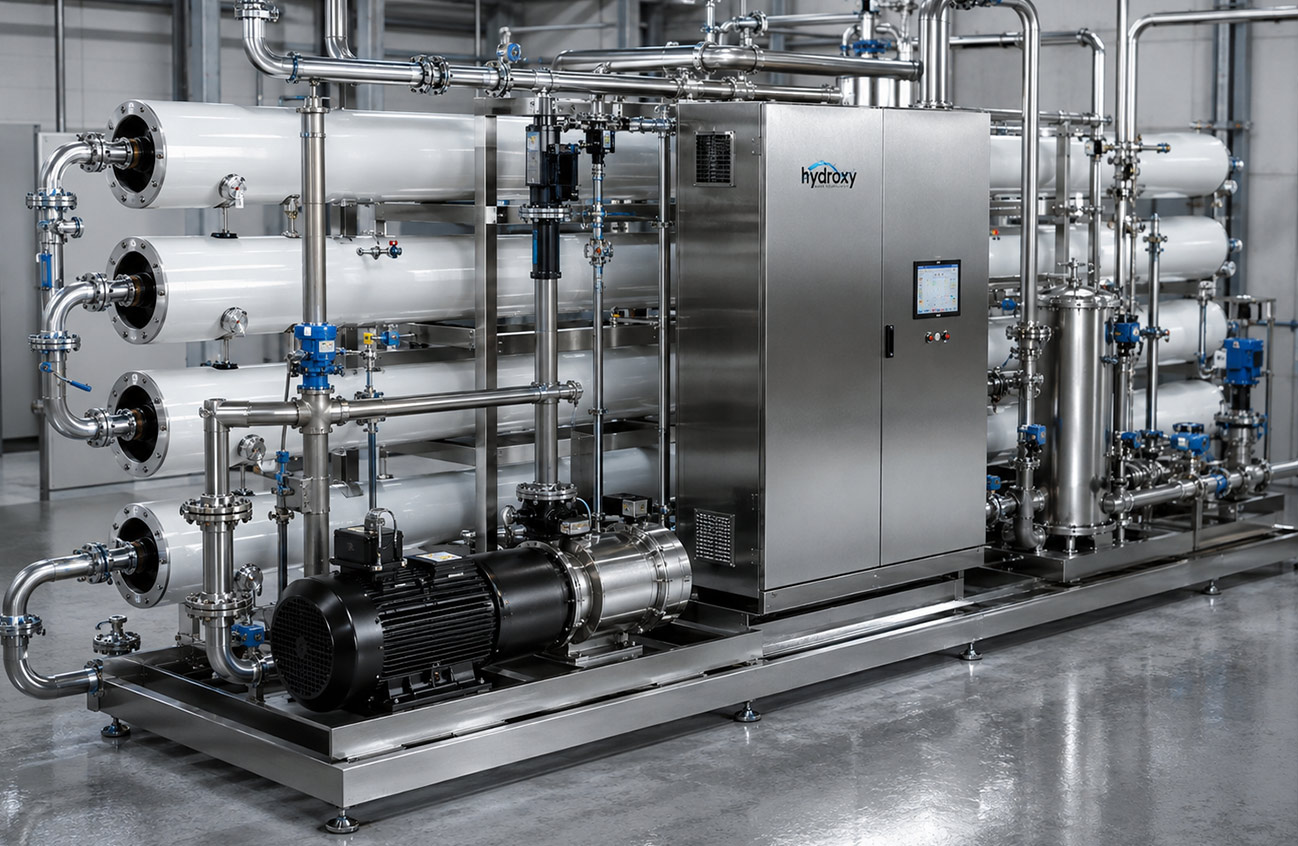
How It Works?!
CCRO combines conventional reverse-osmosis membrane separation with a closed-loop operating cycle designed to provide greater control over recovery and operating conditions.
We evaluate the water source, feed-water chemistry, required treated-water capacity, operating hours and intended application.
Important physical and chemical parameters are assessed to understand membrane fouling, scaling and pre-treatment requirements
Filtration, softening, chemical conditioning, Ultrafiltration or other appropriate treatment processes are selected to protect the membrane system.
Pre-treated feed water enters the RO membrane system while concentrate is recirculated through the closed circuit. Permeate continues to leave the system as treated water while dissolved constituents become progressively concentrated within the recirculating stream.
The system continues operating in closed-circuit mode until predefined operating or recovery conditions are reached. Recovery can be controlled through system software and operating set-points.
At the end of the treatment sequence, concentrated water is flushed from the circuit and replaced with fresh feed water before the next operating cycle continues.
The complete membrane plant is integrated, tested and commissioned against the required capacity, recovery and product-water specifications.
Flow, pressure, conductivity and other process parameters can be monitored by the control system to support adaptation to changing feed-water and operating conditions.
Hydroxy supports continued system performance through preventive maintenance, membrane cleaning, consumables, monitoring and performance optimisation.
Why Hydroxy?
High-recovery Reverse Osmosis requires a different engineering approach from conventional RO.
As recovery increases, the concentration of dissolved constituents rises, making scaling control, membrane hydraulics, pre-treatment and process automation critical to reliable operation.
CCRO provides greater flexibility by allowing recovery, crossflow and operating conditions to be managed independently rather than relying exclusively on a fixed multi-stage configuration.
Hydroxy combines water chemistry expertise, membrane engineering, process integration, automation, practical site execution and lifecycle support to develop high-recovery treatment systems around real operating conditions.
Our approach begins with one important question: "How much more usable water can we recover from your existing feed stream?"
Key Benifits
By increasing the proportion of feed water converted into useful permeate, CCRO can reduce the volume of concentrate requiring discharge or further management compared with lower-recovery conventional RO operation.
CCRO control architecture can adjust operating recovery according to changing feed-water conditions and user-defined parameters, helping maintain treatment objectives when source-water characteristics vary.
The cyclic operating process and periodic concentrate flushing can reduce prolonged exposure of membranes to highly concentrated conditions and provide greater resilience against scaling and fouling challenges.
CCRO uses a single-stage membrane configuration with concentrate recirculation rather than the sequential multi-stage arrangement commonly used in conventional high-recovery RO designs.
Hydroxy evaluates feed-water chemistry, product-water specification, required plant capacity, recovery objectives and operating conditions before defining the appropriate high-recovery membrane treatment configuration.