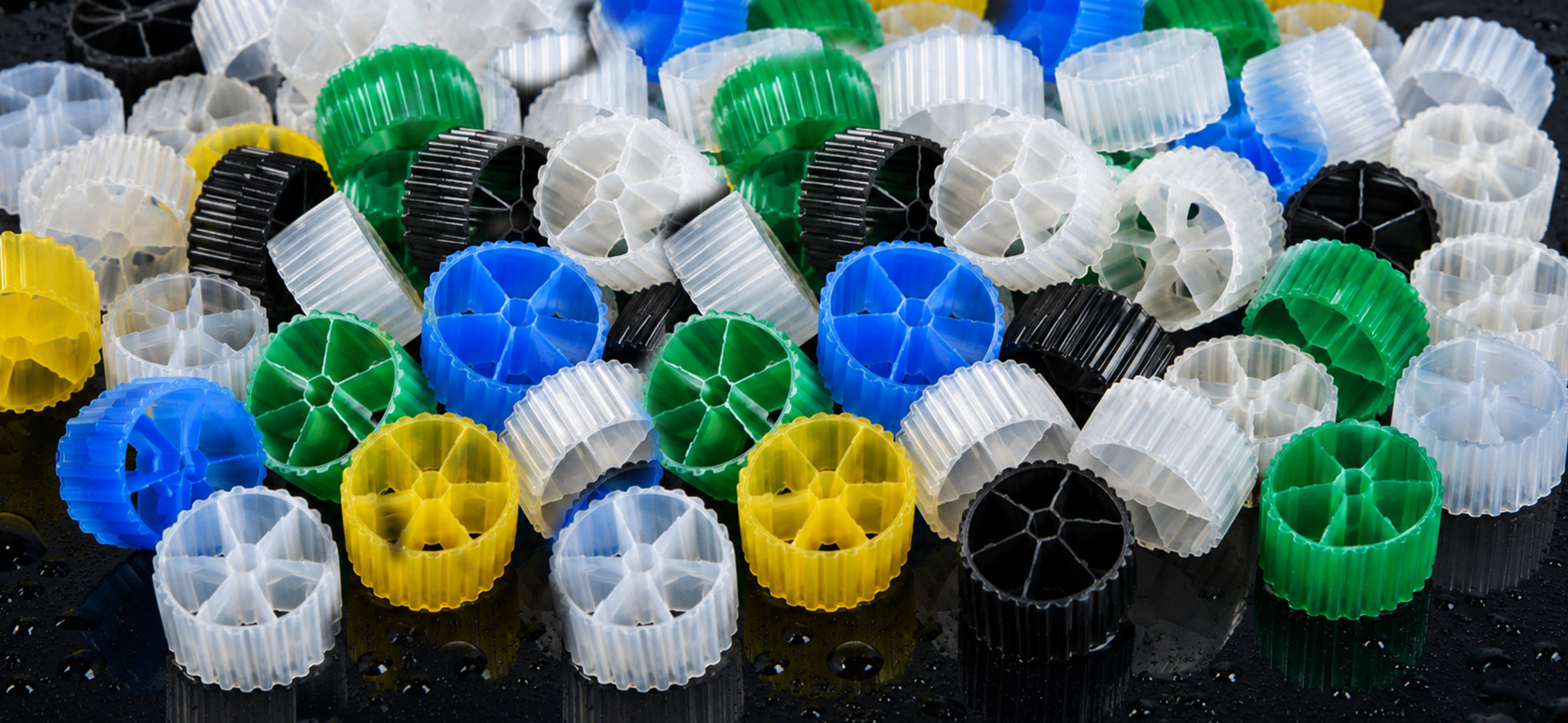
Moving Bed Biofilm Reactors (MBBR)
Hydroxy designs and integrates Moving Bed Biofilm Reactor systems that use specialised carrier media to support biological growth—providing efficient organic-load reduction, stable treatment performance and compact wastewater treatment for demanding applications.
Moving Bed Biofilm Reactors (MBBR)
Moving Bed Biofilm Reactor is a biological wastewater treatment process that uses specially engineered plastic carrier media suspended within an aerated reactor.
The carriers provide a protected surface on which microorganisms naturally develop into an active biofilm.
As wastewater moves through the reactor, organic contaminants come into contact with this biofilm. The microorganisms consume biodegradable pollutants while continuous aeration supplies oxygen and keeps the carrier media moving throughout the reactor.
Because a large quantity of active biomass can be retained on the carrier surfaces, MBBR technology can provide high biological treatment capacity within a relatively compact reactor volume.
Hydroxy Water Technologies designs MBBR systems around wastewater characteristics, organic loading, hydraulic conditions, treatment objectives, carrier-media requirements and operating conditions rather than applying a standard reactor configuration.
The result is a biological treatment process engineered for stable performance, efficient pollutant removal, operational flexibility and dependable long-term operation.

Moving Bed Biofilm Reactors Principle
The core of an MBBR system is the relationship between carrier media, microorganisms, wastewater and oxygen.
Specialised carrier elements provide a large protected surface area where treatment microorganisms can attach and grow.
Microorganisms develop naturally on the protected surfaces of the carriers, creating an active biofilm that remains within the biological reactor.
Aeration keeps the carrier media circulating throughout the reactor, creating continuous contact between wastewater, oxygen and active biofilm.
As wastewater passes through the reactor, microorganisms consume biodegradable organic pollutants, reducing the biological load.
As the biofilm develops, older biomass naturally detaches from the carrier surface and is replaced by new biological growth.
Detached biological solids are separated downstream through an appropriate clarification or solids-separation process. Carrier Media + Active Biofilm + Oxygen + Controlled Hydraulics = Efficient Biological Treatment
Engineered Around Your Biological Load - The Reactor Is Only as Effective as the Biology Inside It
MBBR design should not be based on tank capacity alone. Treatment performance depends on the amount of biodegradable pollution entering the reactor and whether sufficient active biofilm surface area, oxygen transfer and hydraulic contact are available to treat that load.
Hydroxy evaluates important process parameters such as:
- Average & Peak Wastewater Flow
- BOD — Biochemical Oxygen Demand
- COD — Chemical Oxygen Demand
- Ammoniacal Nitrogen, where relevant
- pH, Organic Loading Rate
- Hydraulic Retention Time
- Required BOD / COD Reduction
- Dissolved Oxygen Requirement
- Carrier-Media Surface Area
- Carrier Fill Percentage
- Reactor Mixing Conditions
- Aeration Requirement
- Required Treated-Water Quality
Based on these conditions, Hydroxy determines the appropriate reactor volume, media quantity, aeration capacity and process configuration.
*The objective is not simply to fill a tank with carrier media—it is to create the biological environment required for stable biofilm treatment.
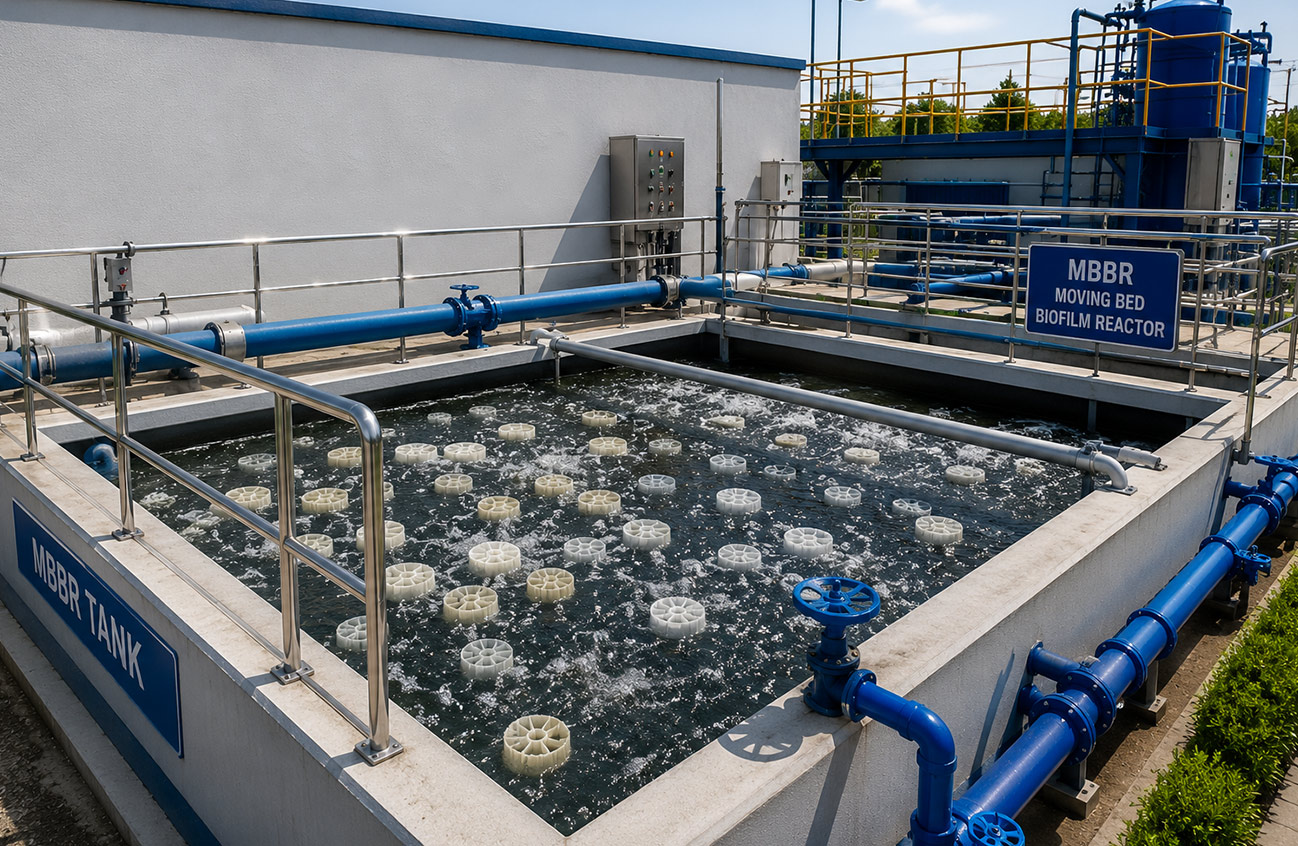
MBBR Carrier Media - The Working Surface of the Biological Process
Carrier media is central to MBBR performance. Each carrier provides protected internal surface area where microorganisms can attach and develop into biofilm while remaining exposed to wastewater and dissolved oxygen.
An effective carrier-media system must consider:
- Protected Surface Area
- Media Geometry
- Media Density
- Fill Percentage
- Biofilm Accessibility
- Hydraulic Movement
- Oxygen Transfer
- Media Retention
- Long-Term Mechanical Stability
Hydroxy selects and sizes carrier media according to the biological load and treatment objective, ensuring that sufficient active surface area is available within the reactor.
Why Protected Biofilm Matters
Unlike freely suspended microorganisms, biofilm grows on a protected carrier surface and remains within the reactor. This allows the biological process to retain a substantial active microbial population and provides resilience when hydraulic or organic loading conditions fluctuate.
MBBR Treatment Process
A Hydroxy MBBR solution integrates biological treatment with the hydraulic, aeration and solids-management systems required to maintain reliable operation.
Wastewater characteristics, hydraulic flow and pollutant loading are evaluated to determine the biological treatment requirement.
Appropriate screening and upstream treatment help prevent debris, fibres and unsuitable solids from interfering with carrier movement and downstream equipment.
Where wastewater flow or pollutant concentration varies significantly, equalisation helps provide a more consistent load to the biological reactor.
Wastewater enters the reactor containing freely moving carrier media. Microorganisms growing on the media consume biodegradable organic contaminants.
Air supplied through the reactor provides oxygen for biological activity while simultaneously keeping the carrier media in continuous motion.
Wastewater repeatedly contacts the active biofilm as carriers circulate through the reactor, supporting continuous biological degradation.
Special retention screens prevent carrier media from leaving the biological reactor while allowing treated mixed liquor to pass to the next process stage.
Excess biological solids leaving the reactor are separated through an appropriately engineered downstream clarification process.
Where higher output quality is required, additional filtration, polishing or disinfection can be incorporated downstream.
How It Works?!
Hydroxy follows a structured approach to ensure the biological reactor, carrier media, aeration and hydraulics work together as one treatment process.
We evaluate flow, BOD, COD, pH, temperature, nitrogen loading and other parameters relevant to biological treatment.
The actual pollutant load entering the treatment process is calculated rather than relying only on daily wastewater volume.
Required reactor volume and hydraulic retention conditions are determined according to treatment objectives and wastewater characteristics.
Media type, protected surface area and fill percentage are selected according to the required biological treatment capacity.
Blower capacity, diffuser arrangement and oxygen-transfer requirements are engineered to support biological activity and maintain carrier movement.
Inlet distribution, reactor mixing, media-retention screens and downstream flow are designed to prevent dead zones and maintain effective treatment conditions.
Blowers, pumps, tank levels, dissolved oxygen and relevant operating parameters can be integrated with automated controls.
The system is progressively commissioned while biofilm establishes on the carrier media and biological operating conditions are stabilised.
Hydraulic conditions, aeration and biological parameters are adjusted according to actual operating performance.
Hydroxy provides preventive maintenance, biological-process monitoring, equipment servicing, troubleshooting and performance optimisation.
MBBR for Capacity Enhancement - More Biological Treatment Without Necessarily Building More Tank Volume
One of the important applications of MBBR technology is upgrading existing biological treatment capacity. When wastewater flow or organic loading increases, existing biological reactors may no longer provide sufficient treatment capacity.
Adding appropriately engineered carrier media can increase the active biological surface available inside an existing reactor, subject to hydraulic, aeration and process feasibility.
Hydroxy can evaluate existing biological treatment infrastructure to identify opportunities for:
- Increased Organic-Load Treatment
- Capacity Enhancement
- Improved Biological Stability
- Improved BOD Reduction
- Improved Nitrification, where required
- Better Response to Load Variations
- Aeration System Optimisation
- Process Automation Improvements
A retrofit must be engineered around the existing reactor hydraulics, aeration capacity and wastewater load—not simply by adding more carrier media.
Aeration & Oxygen Management - Biofilm Needs the Right Oxygen Environment
Aeration performs two critical functions inside an MBBR reactor: It supplies oxygen to the microorganisms and keeps the carrier media moving. Insufficient aeration can reduce biological activity and create poor media circulation, while excessive aeration increases energy consumption without necessarily improving treatment performance.
Hydroxy considers:
- Biological Oxygen Demand
- Required Dissolved Oxygen
- Reactor Depth
- Media Fill Percentage
- Diffuser Configuration
- Oxygen Transfer Efficiency
- Mixing Requirement
- Blower Operating Range
The objective is to provide sufficient oxygen and effective carrier movement with efficient energy utilisation.
Process Monitoring & Automation - Make the Biology Visible to the Operator
Although MBBR is biologically driven, critical operating conditions can be monitored and controlled through appropriate instrumentation.
Depending on the system, Hydroxy can integrate monitoring for:
- Dissolved Oxygen
- pH
- Tank Level
- Airflow
- Blower Operation
- Pump Status
- Flow Rate
- Equipment Faults
- Operating Hours
- Alarm Conditions
PLC-based automation can coordinate pumps, blowers, dosing equipment and other process components while providing operators with clearer visibility into system performance.
Why Hydroxy?
MBBR Is More Than a Tank Filled With Plastic Media
Reliable MBBR treatment requires the correct balance between biological loading, carrier surface area, oxygen transfer, reactor hydraulics and solids separation. Increasing carrier quantity alone does not guarantee better treatment.
Poor media movement, inadequate aeration, incorrect fill ratio, insufficient protected surface area or hydraulic short-circuiting can all reduce biological performance.
Hydroxy approaches MBBR as a complete biofilm-process engineering system, integrating:
- Wastewater Characterisation
- Biological Load Assessment
- Reactor Engineering
- Carrier-Media Selection
- Aeration Design
- Hydraulic Integration
- Media Retention
- Automation
- Commissioning
- Biological Process Support
Our approach begins with one essential question:: "How much active biofilm does your wastewater load actually require?"
Key Benifits
Because membrane separation can replace conventional gravity-based secondary clarification and associated solids-separation stages, MBR can provide a compact treatment configuration where space is limited.
Treated-water separation is achieved through the membrane barrier rather than depending primarily on the settling characteristics of biological sludge.
Membrane retention enables the biological process to maintain higher biomass concentrations and greater control over solids retention compared with many conventional configurations.
Carrier media provides protected surface area for a large population of treatment microorganisms to remain active within the biological reactor.
The high biofilm surface available within the reactor can provide substantial treatment capacity within a comparatively compact biological footprint.
Attached biofilm can provide greater biological retention and help the process respond to variations in hydraulic and organic loading.
Properly engineered MBBR systems provide an effective biological process for reducing biodegradable organic pollutants.
Where treatment requirements include ammonia reduction, MBBR reactors can be engineered with suitable biofilm surface area and operating conditions to support nitrifying microorganisms.
The active biomass remains attached to the carrier media within the reactor, reducing dependence on return sludge for maintaining the principal biofilm population.
MBBR technology can be evaluated for upgrading existing biological reactors where additional treatment capacity is required without proportionally increasing reactor volume.
Aeration, pumps, levels and relevant process parameters can be integrated with PLC-based controls for more consistent and visible operation.
Hydroxy designs the complete MBBR process around actual wastewater loading, carrier-media requirements, oxygen demand and treatment objectives rather than supplying a standard reactor package.