
Iron Removal Systems
Hydroxy designs Iron Removal Systems to reduce dissolved and suspended iron from water helping eliminate reddish-brown staining, metallic taste, deposits and iron-related problems in plumbing and downstream equipment.
Iron Removal Systems
Iron is commonly found in groundwater and borewell sources. It may initially appear as clear dissolved iron but can oxidise when exposed to air, producing yellow, orange or reddish-brown particles and deposits.
Excess iron can cause:
- Reddish-Brown Staining
- Metallic Taste
- Discolouration of Water
- Deposits in Pipelines
- Staining of Bathrooms & Fixtures
- Fouling of Storage Tanks
- Increased Maintenance of Downstream Equipment
Hydroxy Water Technologies designs Iron Removal Systems according to incoming iron concentration, water chemistry, required flow and intended application. The objective is to convert dissolved iron into a form that can be effectively captured and removed through filtration.

Iron Removal Principle
Iron removal typically works through a combination of oxidation and filtration.
Iron may be present in water in a dissolved form that cannot be effectively removed through ordinary particle filtration alone.
Air or an appropriate oxidation process converts dissolved iron into insoluble iron particles.
The oxidised iron is captured within specially selected filtration media.
Treated water leaves the filter with substantially reduced iron content.
Accumulated iron deposits are periodically removed from the media bed through backwashing. Iron-Bearing Water → Oxidation → Iron Precipitation → Media Filtration → Treated Water
Engineered Around Your Iron Level - Iron Removal Is a Water-Chemistry Problem
An Iron Removal System should not be selected only by vessel size or flow capacity. Successful treatment depends on understanding the concentration and condition of iron in the incoming water. Hydroxy evaluates parameters such as:
- Total Iron Concentration
- Dissolved Iron
- Water pH
- Turbidity
- Required Flow Rate
- Daily Water Consumption
- Oxidation Requirement
- Media Selection
- Contact Time
- Operating Pressure
- Backwash Requirement
- Required Treated-Water Quality
These factors determine the appropriate oxidation method, filter-media configuration, vessel size and operating conditions. The objective is to treat the iron present in your water—not simply install a standard filter.
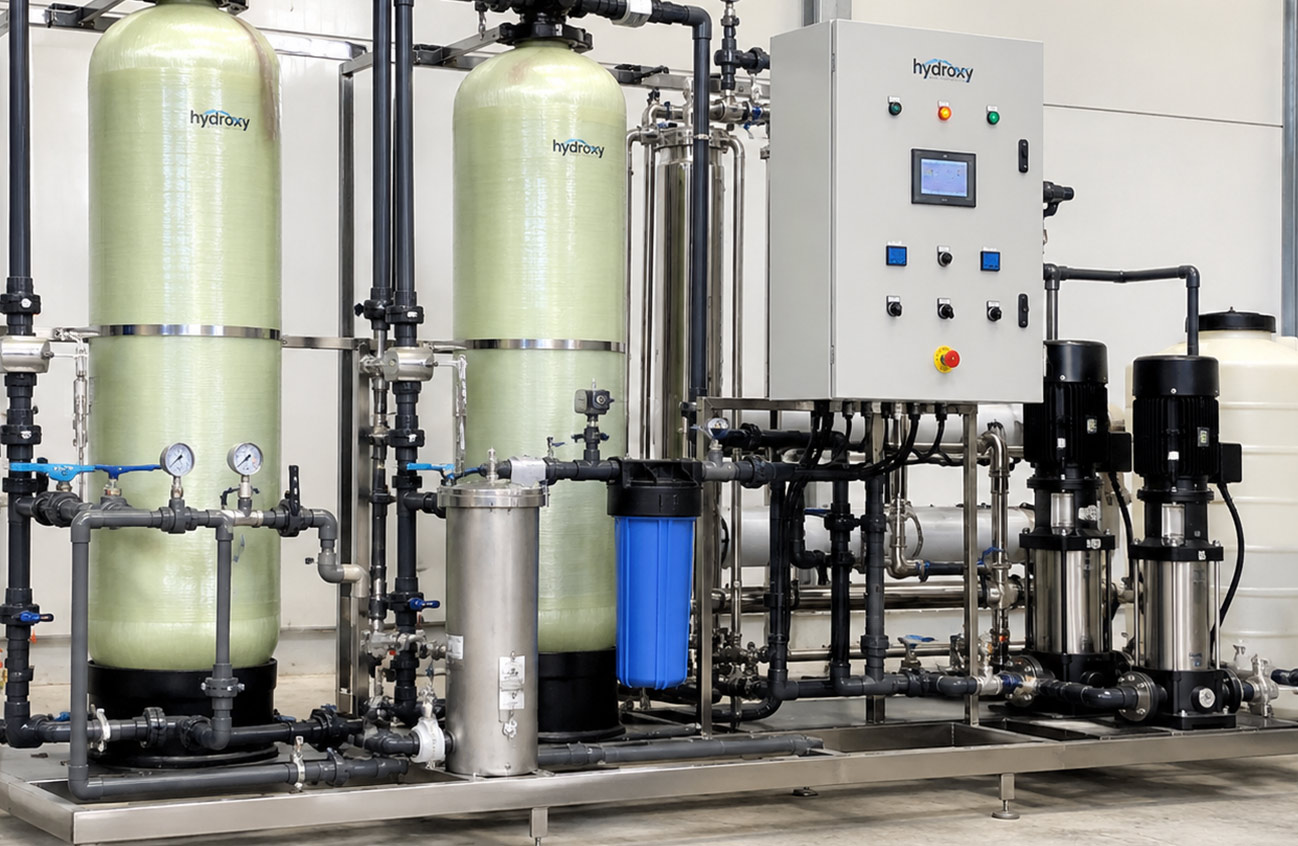
How It Works - From Iron-Bearing Water to Clearer Treated Water
Incoming water is tested to determine iron concentration and other relevant water-quality parameters.
Dissolved iron is converted into insoluble particles using an appropriate oxidation method.
Sufficient reaction conditions are provided to allow iron to convert into a filterable form.
Provides membrane-based removal of fine suspended particles, colloidal matter and microorganisms.
Water passes through the selected filtration media, where oxidised iron particles are retained.
Filtered water leaves the vessel for storage, distribution or further treatment.
The filter is periodically backwashed to remove accumulated iron deposits and restore hydraulic performance.
Iron Removal Media & System Configuration - Treatment Selected Around Your Water
Different water conditions may require different filtration-media and oxidation approaches. Hydroxy selects the system configuration according to:
- Iron Concentration
- Water pH
- Required Flow Rate
- Oxidation Requirement
- Inlet Turbidity
- Media Loading
- Backwash Availability
- Operating Frequency
Depending on the application, the system may incorporate:
- Aeration
- Oxidation
- Contact Tank
- Iron Removal Media
- Pressure Filtration Vessel
- Automatic Control Valve
- Backwash System
- Flow & Pressure Monitoring
The final configuration is determined from the actual water analysis.
Typical Applications
Hydroxy Iron Removal Systems can be used for:
- Borewell Water
- Groundwater
- Residential Water Supply
- Apartments & Villas
- Hotels & Resorts
- Hospitals & Institutions
- Commercial Buildings
- Industrial Utility Water
- Process-Water Pre-Treatment
Automatic & Manual Operation - Designed Around Your Operating Requirement
Suitable where filtration and backwashing are controlled directly by an operator.
Automatic control valves can manage filtration, backwashing and rinsing cycles with reduced manual intervention.
The appropriate configuration depends on system capacity, operating hours and maintenance requirements.
Why Hydroxy? - Effective Iron Removal Begins With Understanding the Water
Iron treatment is not simply a filtration problem. If dissolved iron is not properly converted into a filterable form, even a correctly sized filter may provide inconsistent performance.
Hydroxy considers the complete relationship between: Iron Concentration + Water Chemistry + Oxidation + Media + Flow + Backwashing
This allows us to engineer Iron Removal Systems around actual site conditions rather than relying on a generic filter configuration.
Our approach begins with one question: "What form and concentration of iron is present in your water?"
Key Benifits
Helps remove dissolved and oxidised iron from incoming water.
Iron removal helps minimise staining on sanitary fittings, tiles, sinks, tanks and other water-contact surfaces.
Reducing iron can help address yellow, orange or reddish discolouration associated with iron-bearing water.
Iron removal helps minimise iron deposits in pipelines, storage tanks and water-using equipment.
Systems can be configured for automated backwashing and rinsing to maintain filtration performance.
Removing iron before downstream treatment can help reduce fouling and contamination of other water-treatment equipment.
Hydroxy selects the oxidation process, filtration media, vessel size and backwash configuration according to the actual iron concentration and operating requirements.
A standard sand filter may remove visible iron particles but may not effectively remove dissolved iron. Dissolved iron usually needs to be converted into an insoluble form before it can be captured through filtration.
Oxidation first. Filtration second. Reliable iron removal follows.