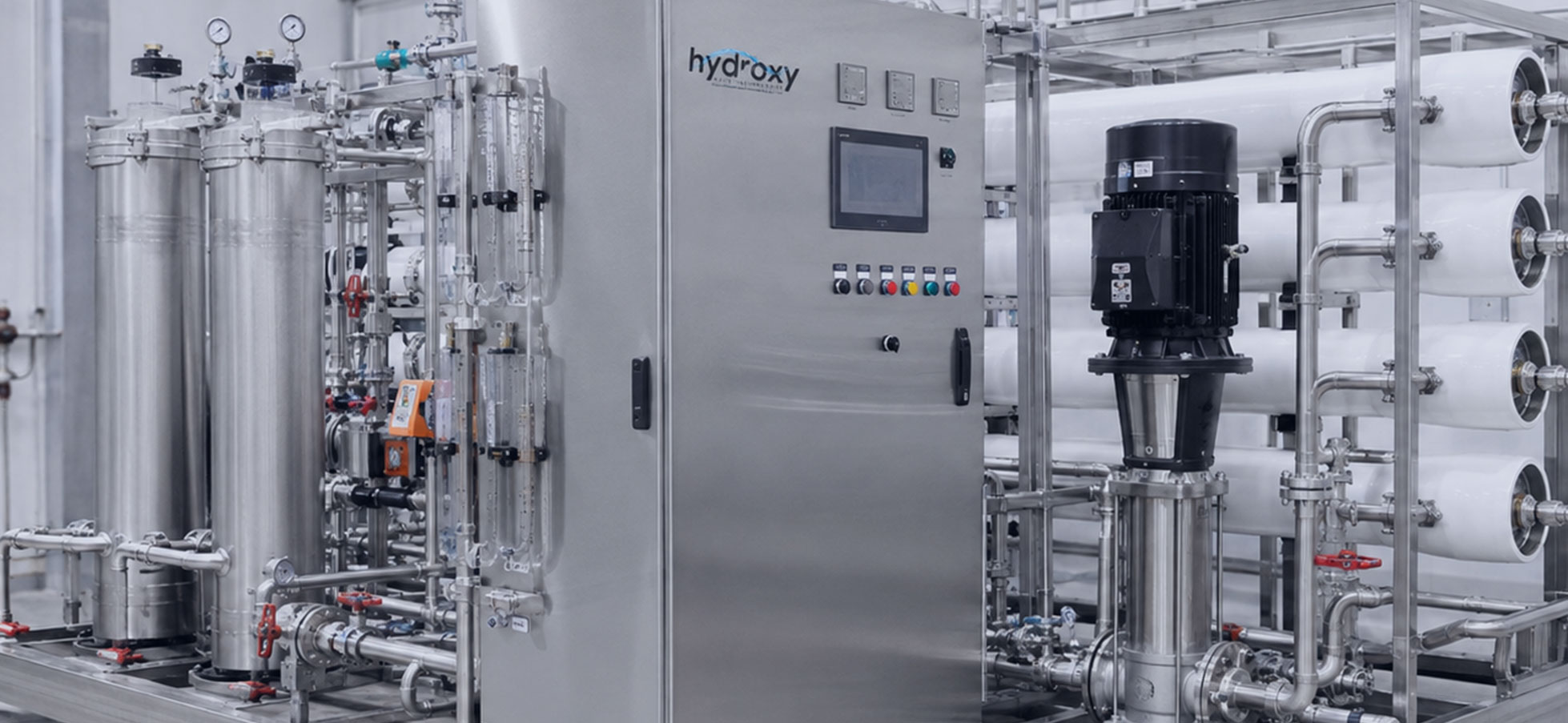
Nano Filtration (NF)
Hydroxy designs Nanofiltration systems to reduce hardness, colour, organic matter and selected dissolved contaminants—delivering efficient treatment where full Reverse Osmosis is not required.
Nano Filtration (NF)
Nanofiltration is a pressure-driven membrane treatment process positioned between Ultrafiltration and Reverse Osmosis.
NF membranes are designed to selectively reduce hardness-causing minerals, multivalent ions, colour, larger organic molecules and selected dissolved contaminants, while allowing a greater proportion of monovalent salts to pass compared with conventional RO.
This makes Nanofiltration suitable for applications where complete demineralisation is unnecessary, but more advanced treatment than conventional filtration is required.
Hydroxy Water Technologies designs site-specific Nanofiltration systems based on feed-water chemistry, target contaminant reduction, required product-water quality, plant capacity, recovery requirements and operating conditions.
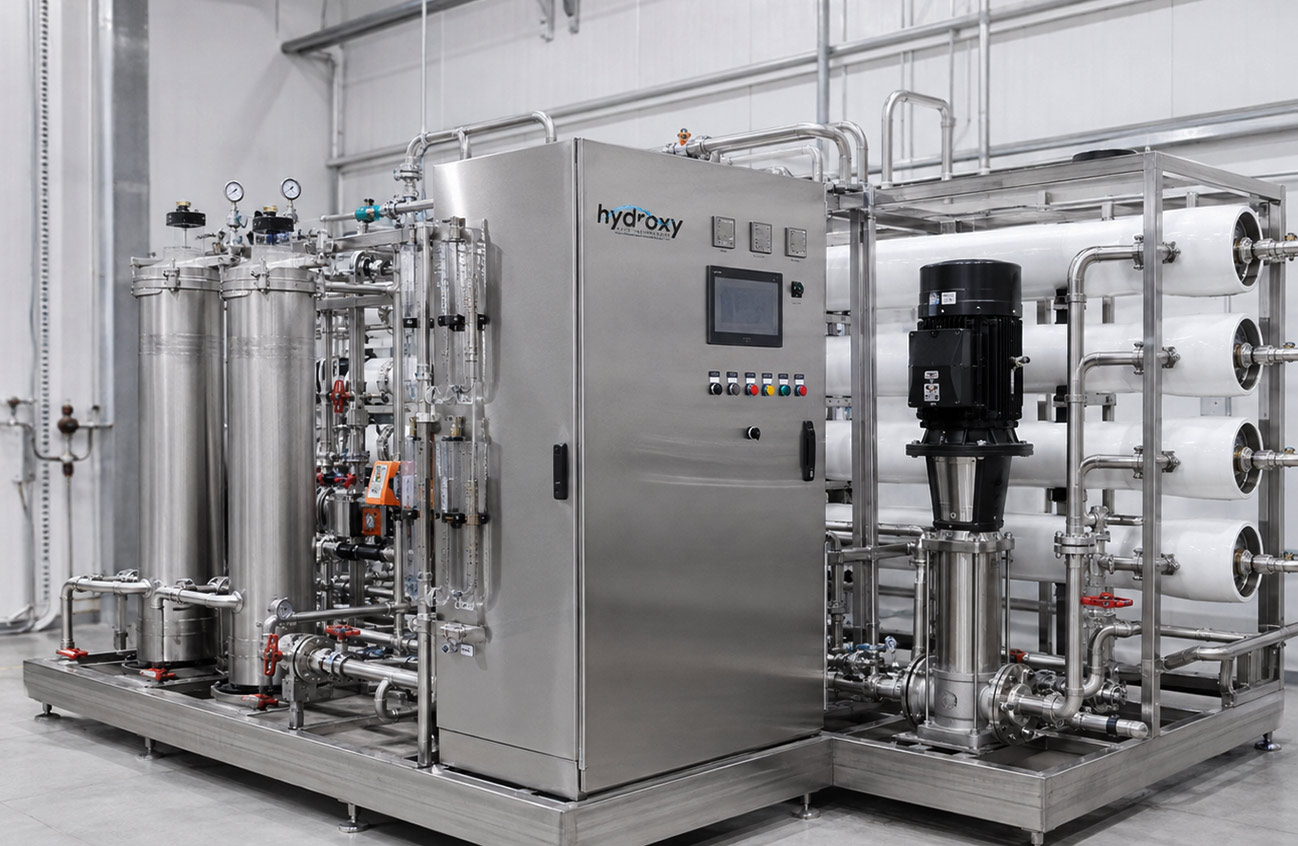
From pre-treatment and high-pressure pumping to membrane separation, monitoring and automation, Hydroxy integrates each stage into a complete NF treatment process engineered for selective contaminant removal, stable water quality and efficient long-term operation.

Advanced Treatment Where Selective Mineral Reduction Matters
In certain residential and community applications, incoming water may contain excessive hardness, colour or specific dissolved contaminants without requiring the full mineral rejection associated with Reverse Osmosis.
Hydroxy provides NF-based treatment solutions where selective membrane separation can offer an efficient approach to improving water quality.
- Hard Water Treatment
- Community Water Systems
- Borewell Water Treatment
- Colour Reduction
- Selective Mineral Reduction
- Drinking-Water Pre-Treatment
Efficient Membrane Treatment for Controlled Water Quality
Commercial and institutional facilities often require better control of hardness, colour, organic loading and selected dissolved contaminants while maintaining an efficient water-treatment process.
Hydroxy engineers commercial Nanofiltration plants around feed-water chemistry, required product-water quality, recovery targets and operational demand.
- Hotels & Resorts
- Hospitals & Healthcare Facilities
- Food & Beverage Facilities
- Commercial Buildings
- Institutional Campuses
- Process Water Applications
Engineered Around Selective Contaminant Removal
Nanofiltration should not be selected solely based on plant capacity. Its effectiveness depends on understanding which contaminants need to be reduced and which minerals can remain in the treated water.
Unlike Reverse Osmosis, which is designed for broad dissolved-solids rejection, Nanofiltration can provide more selective separation. This makes membrane selection and feed-water analysis particularly important.
Hydroxy evaluates design parameters such as:
- Total Hardness & TDS
- Calcium, Magnesium, Sulphates
- Colour, Organic Matter
- pH, Turbidity, Iron & Manganese
- Required Product-Water Quality
- Target Recovery
- Required Plant Capacity
Depending on the application, an NF system may incorporate:
- Multimedia / Pressure Sand Filtration
- Activated Carbon Filtration
- Micron Cartridge Filtration
- Chemical Conditioning
- Antiscalant Dosing
- High-Pressure Pump
- Nanofiltration Membrane Array
- Permeate & Reject Monitoring
- Conductivity Monitoring
- PLC / Automated Controls
- Clean-in-Place provisions, where required
*The result is a Nanofiltration system engineered around the contaminants you need to reduce—not a standard membrane configuration.
How It Works?!
Hydroxy follows a structured engineering approach to ensure that pre-treatment, membrane selection and operating conditions work together as one integrated NF process.
We understand the water source, feed-water quality, required plant capacity, operating hours and intended application.
Key chemical and physical parameters are evaluated to identify hardness, dissolved contaminants, organic loading and membrane-treatment requirements.
The appropriate NF membrane and pre-treatment process are selected according to the contaminants that need to be reduced and the required product-water quality.
Filtration, activated carbon treatment, chemical dosing or other appropriate processes are used where required to protect the NF membranes and improve system stability.
Pre-treated water is pressurised through NF membranes, which selectively reject targeted ions and larger dissolved substances while allowing other components to pass according to the membrane characteristics.
Flow, pressure, conductivity and other operating parameters can be monitored through instrumentation and automatic control systems to support consistent performance.
The complete NF plant is installed, tested and commissioned according to the specified operating parameters and treated-water requirements.
Hydroxy provides preventive maintenance, membrane cleaning, replacement support, consumables and system optimisation throughout the equipment lifecycle.
Why Hydroxy?
Successful Nanofiltration requires more than simply installing a membrane system. The key advantage of NF is selectivity, which means the system must be carefully engineered around the feed-water chemistry and the exact contaminants that need to be reduced.
Incorrect membrane selection or inadequate pre-treatment can lead to scaling, fouling, reduced recovery, inconsistent output quality and unnecessary operating costs.
Hydroxy combines water chemistry expertise, membrane engineering, process integration, automation, practical site execution and responsive lifecycle support to develop NF systems designed for dependable long-term operation.
Our approach begins with one important question: "What do you need to remove and what should remain in the treated water?"
Key Benifits
NF can provide an effective membrane-based approach for reducing calcium and magnesium hardness in applications where complete demineralisation is not required.
Appropriate NF membranes can help reduce colour and higher-molecular-weight organic substances, improving treated-water quality for selected applications.
Depending on feed-water chemistry and treatment objectives, Nanofiltration can operate at lower pressure than traditional RO systems, offering an efficient option where full dissolved-solids rejection is unnecessary.
Membrane selection can be tailored to achieve the required balance between contaminant reduction and retention of selected dissolved minerals.
Hydroxy designs NF systems according to feed-water chemistry, contaminants of concern, required product-water quality, capacity and recovery targets rather than using a standard membrane package.