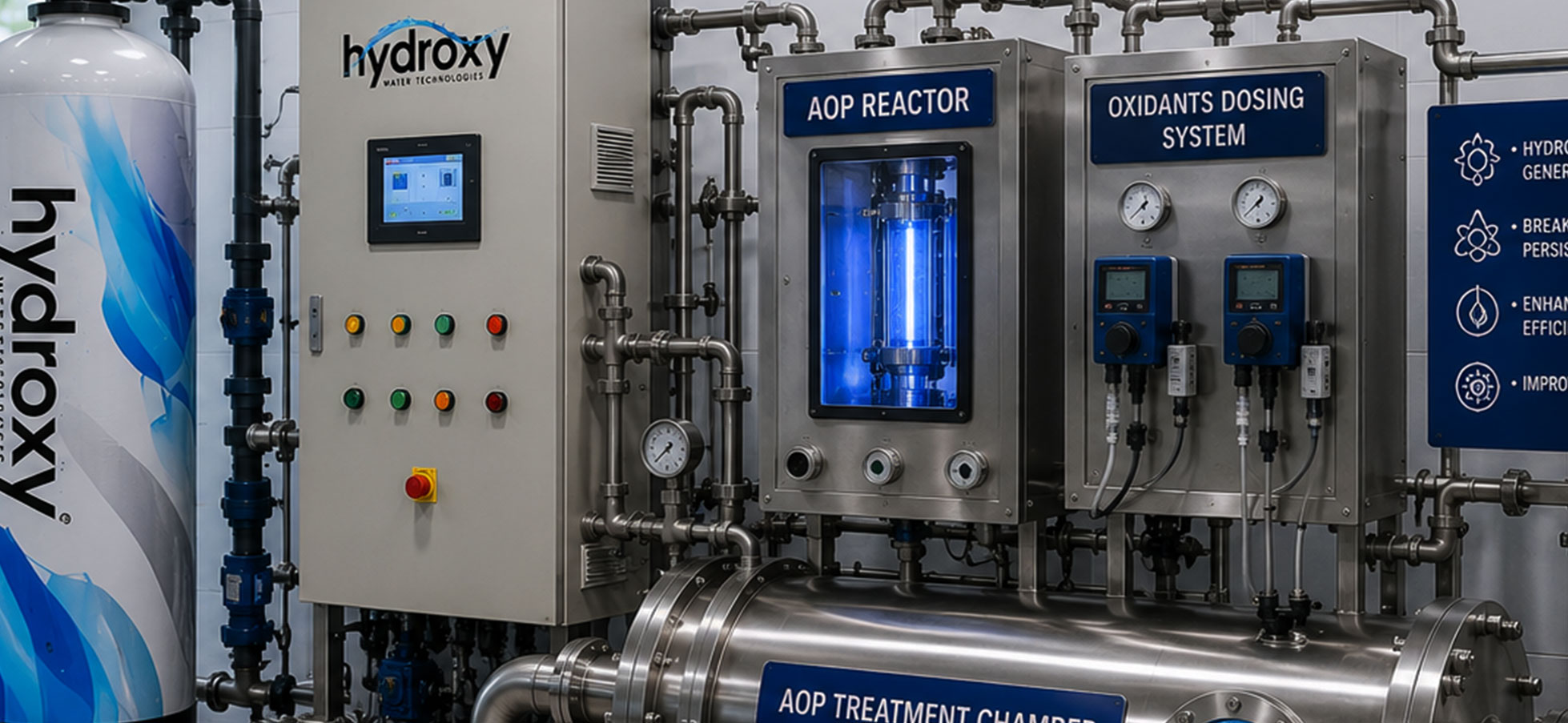
Advanced Oxidation Process (AOP)
Powerful oxidation for difficult-to-treat water contaminants. Hydroxy designs Advanced Oxidation Process systems that generate highly reactive oxidising species to break down selected organic contaminants, improve water quality and provide an advanced treatment barrier for demanding water applications.
Advanced Oxidation Process (AOP)
Advanced Oxidation Processes are water-treatment technologies designed to generate highly reactive species—particularly hydroxyl radicals (•OH)—that can rapidly oxidise many organic contaminants. These radicals can be generated by combining treatment technologies such as:
- UV + Hydrogen Peroxide
- Ozone + Hydrogen Peroxide
- UV + Ozone
Hydroxyl radicals are highly reactive and can attack organic compounds that may be difficult to treat effectively using conventional oxidation alone.
Hydroxy Water Technologies designs AOP systems according to water chemistry, contaminant characteristics, required oxidation performance, flow capacity and operating conditions.

AOP Treatment Principle
The central principle of AOP is to generate reactive oxidising species directly within the treatment process.
UV energy, ozone, hydrogen peroxide or an appropriate combination is introduced into the process.
The interaction between the selected processes produces highly reactive hydroxyl radicals.
Hydroxyl radicals react rapidly with susceptible organic contaminants, transforming them into simpler compounds.
UV intensity, chemical dose, contact conditions and water flow are controlled according to the required treatment objective.
Water leaves the AOP reactor after the required oxidation exposure.
UV / Ozone / H₂O₂ → Hydroxyl Radicals → Contaminant Oxidation → Treated Water
EPA describes AOPs as processes that generate hydroxyl radicals and identifies combinations including UV/H₂O₂, UV/O₃ and O₃/H₂O₂.
Engineered Around Your Oxidation Demand - AOP Is Not Selected by Flow Rate Alone
Chlorination should not be based only on water flow. Some of the added chlorine may be consumed by organic matter, iron, manganese, ammonia and other reactive substances before an effective disinfectant residual is achieved. Hydroxy evaluates important parameters such as:
- Contaminants of Concern
- Required Water Flow
- Total Organic Carbon — TOC
- UV Transmittance — UVT
- Turbidity
- pH, Alkalinity
- Oxidant Demand
- Hydrogen Peroxide Dose
- Ozone Dose, where applicable
- UV Intensity / Exposure
- Contact Time
- Required Treatment Performance
Carbonate, bicarbonate and other water-matrix constituents can consume reactive radicals and influence oxidation efficiency, making feed-water characterisation an important part of AOP design.
The objective is to generate the required oxidation capacity efficiently—not simply apply more UV or more chemical.
Common AOP Configurations
Hydrogen peroxide is introduced into the water and exposed to UV radiation, generating hydroxyl radicals that oxidise susceptible contaminants.
UV/H₂O₂ is used for treatment of selected organic micropollutants and compounds that can be difficult to address through conventional processes.
Also known as peroxone, this process combines ozone and hydrogen peroxide to accelerate hydroxyl-radical formation.
The combination provides an advanced oxidation mechanism beyond ozone treatment alone.
Ozone combined with UV radiation can generate hydroxyl radicals and provide enhanced oxidation of selected contaminants
The appropriate configuration is determined by the water characteristics and treatment objective.
Typical AOP Applications
AOP can be considered for applications involving:
- Trace Organic Contaminants
- Difficult-to-Oxidise Organic Compounds
- Taste & Odour Control
- Advanced Drinking-Water Treatment
- Process Water Polishing
- High-Purity Water Applications
- Advanced Water Reuse
- Post-RO Advanced Treatment
- Selected Industrial Water Applications
EPA identifies UV-AOP as useful for reducing certain organic micropollutants and for treatment of some taste-and-odour issues.
How It Works - From Contaminated Water to Advanced Oxidation
Hydroxy evaluates water chemistry and identifies the contaminants that need to be oxidised.
The appropriate combination of UV, ozone, hydrogen peroxide or other suitable oxidation components is determined.
Oxidant dose and energy input are engineered according to water flow and contaminant demand.
The selected process generates highly reactive hydroxyl radicals within the treatment system.
Reactive radicals attack susceptible organic contaminants as the water passes through the treatment process.
The combination provides an advanced oxidation mechanism beyond ozone treatment alone.
Operating parameters are monitored and adjusted to maintain treatment performance and efficient oxidant utilisation.
Typical System Components
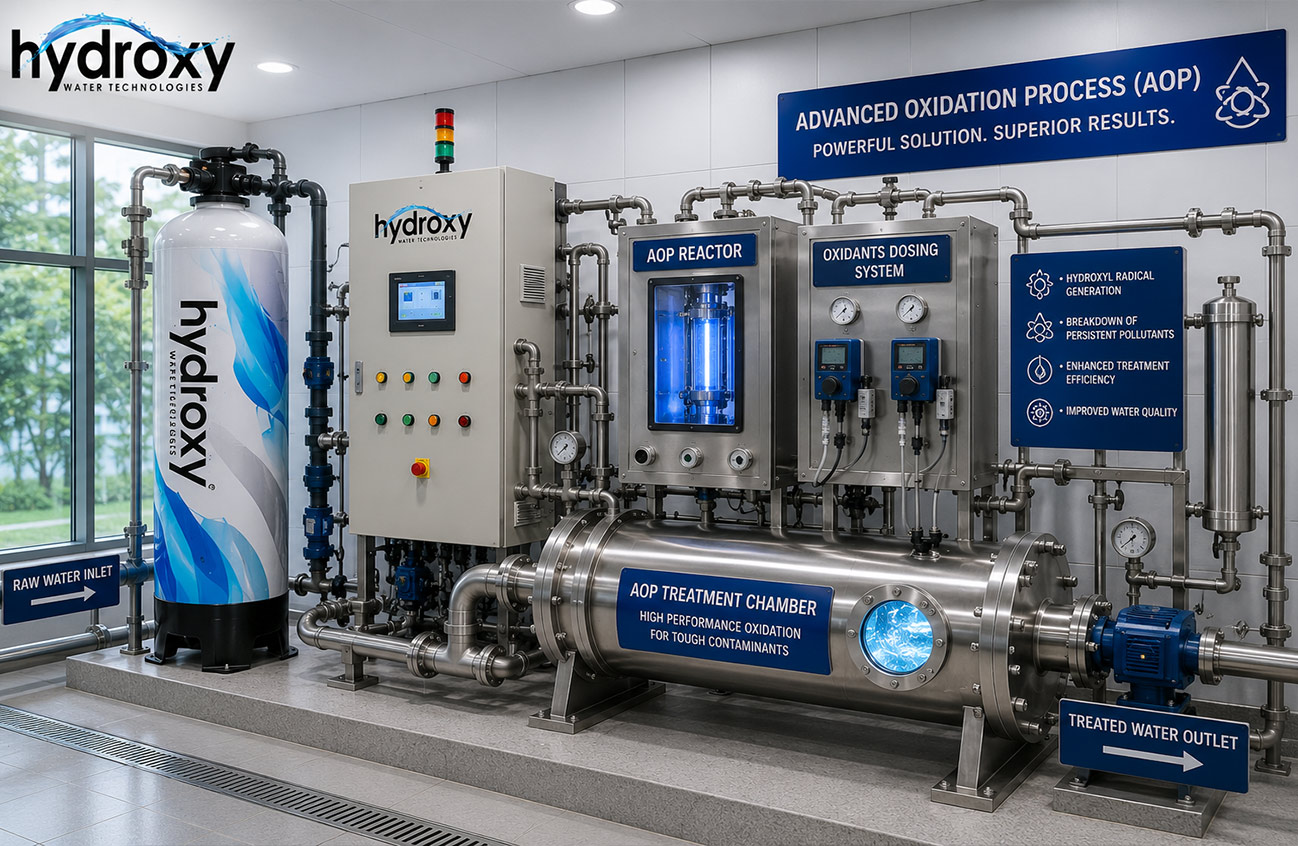
Depending on the selected AOP configuration, a Hydroxy system may incorporate:
- UV Reactor
- UV Lamps & Power Supply
- Hydrogen Peroxide Storage
- Precision Dosing Pumps
- Ozone Generator
- Ozone Injection System
- Contact Reactor
- Static Mixer
- Flow Monitoring
- UV Intensity Monitoring
- Chemical-Level Monitoring
- ORP / Relevant Process Instrumentation
- PLC / HMI Controls
- Safety Interlocks
The final configuration is selected around the specific AOP chemistry and treatment objective.
Typical AOP Applications
Hydroxy AOP systems can integrate monitoring and automated control for:
- Water Flow
- UV Lamp Status
- UV Intensity
- Hydrogen Peroxide Dosing
- Ozone Output
- Chemical Tank Levels
- Equipment Status
- Treatment Sequence
- Safety Interlocks
- Alarm Conditions
Automation helps coordinate energy input and oxidant dosing with actual operating demand.
Why Hydroxy? - AOP Performance Starts With Understanding the Water Matrix
Advanced oxidation is not simply a combination of UV and chemicals. Reliable performance depends on the relationship between:
Contaminants + Water Chemistry + Radical Generation + Oxidant Dose + Energy + Contact Conditions
Some substances present in the water can consume hydroxyl radicals before they react with the target contaminants.
Hydroxy therefore designs AOP systems around the actual contaminant profile, water matrix and required treatment objective, rather than applying a standard oxidation package.
Our approach begins with one essential question: "What needs to be oxidised and what is competing for the available radicals?"
Key Benifits
Hydroxyl radicals can oxidise selected organic contaminants that may be difficult to address through conventional oxidation processes.
AOP intentionally generates highly reactive radical species to increase oxidation capability.
UV/H₂O₂, O₃/H₂O₂ and UV/O₃ can be selected according to the treatment requirement.
AOP can provide an additional treatment barrier where conventional treatment alone does not achieve the required contaminant reduction.
UV output, oxidant dosing, water flow and other operating parameters can be integrated with PLC-based controls.
Hydroxy develops the AOP configuration around water chemistry, contaminants of concern, required flow and treatment objective rather than simply selecting equipment capacity.
AOP is primarily designed to chemically transform susceptible contaminants through oxidation.
It does not function as the primary process for removing: Suspended Sediment, Hardness, TDS and Dissolved Mineral Salts
Its strength lies in generating powerful reactive species to address selected contaminants that require advanced oxidation. Generate radicals → attack contaminants → transform them through oxidation.