
Sewage Treatment Plants (STP)
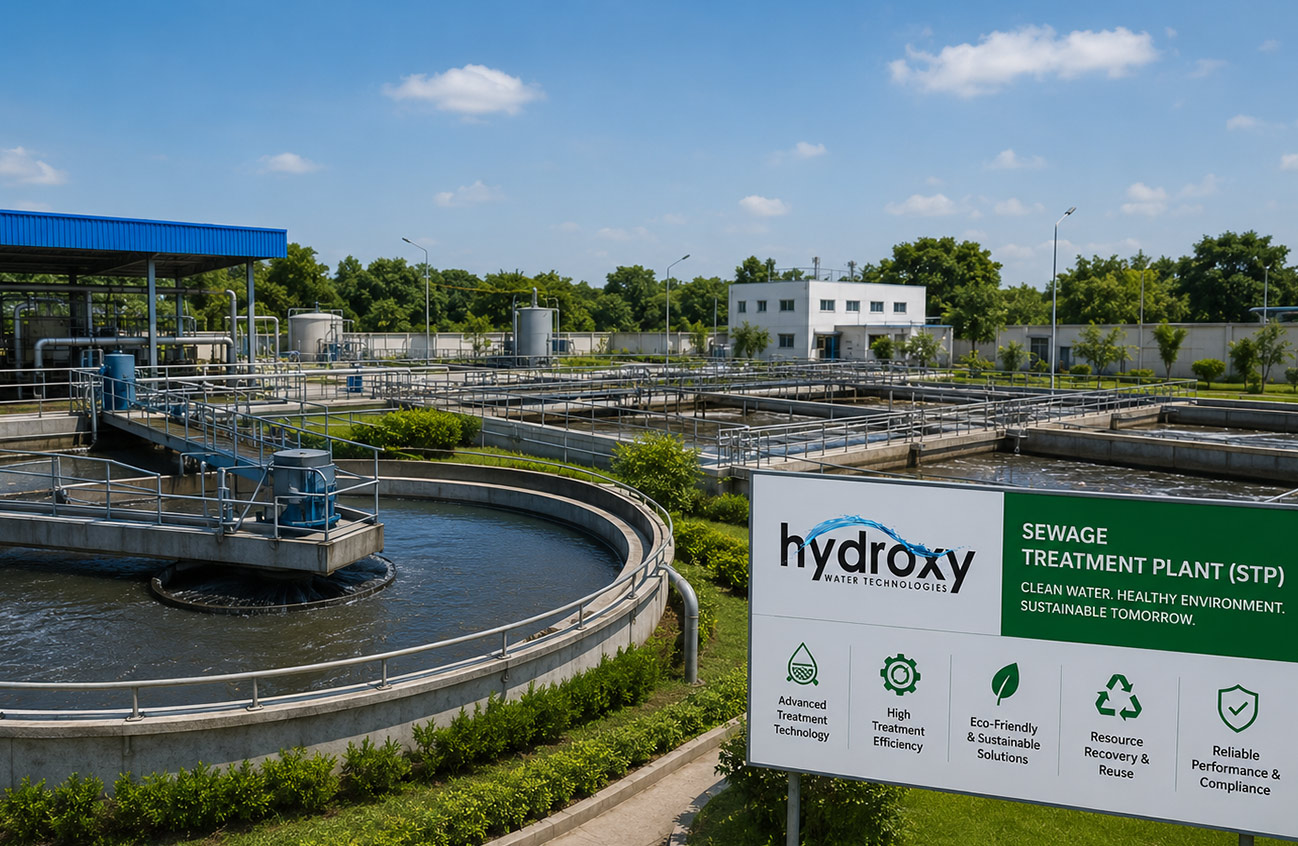
Hydroxy designs and delivers Sewage Treatment Plants engineered to treat domestic wastewater through integrated biological, filtration and disinfection processes—helping residential, commercial and institutional facilities achieve reliable treatment and maximise opportunities for treated-water reuse.
Sewage Treatment Plants (STP)
Sewage generated from residential communities, hotels, hospitals, educational institutions, offices and commercial facilities contains organic matter, suspended solids, nutrients, detergents and microorganisms that require appropriate treatment before discharge or reuse.
Effective sewage treatment involves much more than simply removing visible solids. The complete process must manage variations in flow and organic loading while maintaining the biological conditions required for stable treatment performance.
Hydroxy Water Technologies designs site-specific Sewage Treatment Plants based on wastewater characteristics, daily flow, peak load, available space, treated-water requirements and intended reuse or discharge conditions.
From screening and equalisation to biological treatment, clarification, tertiary filtration and disinfection, Hydroxy integrates each stage into a complete treatment process engineered for reliable wastewater treatment, efficient operation and long-term lifecycle performance.

Reliable Sewage Treatment for Modern Communities
Apartments, villas, gated communities and residential developments generate wastewater continuously, with significant variations in flow between peak and low-demand periods.
Hydroxy designs residential STPs to manage these changing loads while producing treated water that can be considered for appropriate non-potable reuse applications, subject to the required treatment standard and local regulations.
- Apartment Complexes
- Gated Communities
- Residential Townships
- Villas & Housing Projects
- Hostels & Residential Campuses
- Community Wastewater Treatment
Dependable Treatment for High-Occupancy Facilities
Commercial and institutional properties require sewage treatment systems capable of managing variable occupancy, organic loads and operational demands.
Hydroxy engineers STPs around the actual sewage generation profile, treatment requirement and intended treated-water application, combining biological treatment, filtration, disinfection and automated process controls.
- Hotels & Resorts
- Hospitals & Healthcare Facilities
- Schools & Educational Institutions
- Office & Commercial Buildings
- Shopping & Mixed-Use Developments
- Industrial & Institutional Campuses
Engineered Around Your Sewage Load & Reuse Objective
A Sewage Treatment Plant should not be selected only according to its KLD capacity.Treatment performance depends on understanding both the hydraulic load and pollution load entering the plant.
Occupancy patterns, wastewater characteristics, organic loading, peak flows, treatment objectives and reuse requirements all influence the appropriate biological process and system configuration.
Hydroxy evaluates important design parameters such as:
- Daily Sewage Generation
- Peak & Average Flow
- BOD — Biochemical Oxygen Demand
- COD — Chemical Oxygen Demand
- Total Suspended Solids(TDS) & pH
- Operating Hours
- Organic Loading
- Occupancy & Usage Pattern
- Available Installation Area
- Required Treated-Water Quality
- Intended Reuse / Discharge Requirement
- Operating & Automation Requirements
Depending on the application, a Hydroxy STP may incorporate:
- Bar Screening
- Oil & Grease Separation, where required
- Collection & Equalisation
- Biological Treatment
- Aeration System
- Secondary Clarification
- Sludge Recirculation
- Sludge Holding & Dewatering
- Pressure Sand / Multimedia Filtration
- Activated Carbon Filtration
- Ultrafiltration, where required
- Disinfection
- Treated-Water Storage
- Automated Controls & Instrumentation
*The result is an STP engineered around the actual wastewater load, treatment objective and reuse requirement rather than a standard packaged configuration.
How It Works?!
Hydroxy follows a structured treatment process to progressively remove solids, organic pollutants and other contaminants before the treated water is discharged or reused for an appropriate application.
Incoming wastewater is collected and passed through screening to remove larger solids and debris that could interfere with pumps and downstream treatment equipment.
Wastewater enters an equalisation tank where variations in incoming flow and pollutant concentration are balanced to provide a more consistent feed to the biological treatment stage.
Microorganisms break down biodegradable organic matter under controlled conditions. Depending on the project requirements, Hydroxy can engineer treatment around technologies.
Biological solids are separated from treated water through clarification or membrane separation, depending on the selected treatment process.
Where higher treated-water quality is required, filtration stages such as multimedia filtration, activated carbon treatment or membrane filtration can be incorporated.
An appropriate disinfection process is applied where required before treated water enters storage or its intended reuse system.
Excess biological sludge generated by the treatment process is collected and managed through suitable sludge holding, thickening or dewatering arrangements.
Subject to the required water quality and applicable requirements, treated sewage can be considered for non-potable applications such as landscape irrigation, toilet flushing and other suitable utility uses.
Pumps, blowers, level controls, dosing systems and treatment cycles can be integrated with automated controls to improve operational consistency and reduce routine manual intervention.
Hydroxy supports ongoing STP operation through preventive maintenance, biological process monitoring, equipment servicing, consumables and performance optimisation.
Why Hydroxy?
SSuccessful sewage treatment requires much more than supplying tanks, pumps, blowers and filters.
An STP is a living biological process. Its performance depends on maintaining the correct relationship between wastewater loading, aeration, microorganisms, hydraulic retention, sludge management and downstream treatment.
Incorrect sizing or inadequate process control can lead to odour, unstable biological treatment, poor treated-water quality, excessive sludge generation and higher operating costs.
Hydroxy combines wastewater process engineering, biological treatment expertise, practical site execution, automation and responsive lifecycle support to deliver STPs designed for dependable real-world operation.
From initial wastewater assessment to commissioning and long-term maintenance, our approach begins with one fundamental question: "What treatment process will consistently achieve your required water quality and reuse objective?"
Key Benifits
Tertiary treatment and disinfection can prepare treated sewage for appropriate non-potable reuse applications, helping facilities make better use of available water resources.
The membrane process can retain suspended contaminants and many microorganisms, making UF an effective treatment stage for applications requiring a higher level of physical filtration.
UF can provide effective pre-treatment before Reverse Osmosis by reducing turbidity and suspended contaminants that may contribute to downstream membrane fouling.
Reusing appropriately treated wastewater for landscaping, flushing and suitable utility applications can reduce dependence on freshwater for non-potable requirements.
Pumps, blowers, treatment cycles, level controls and dosing systems can be integrated with automation to improve process consistency and simplify routine operation.
Hydroxy determines STP capacity and process configuration according to sewage generation, organic load, peak flow, occupancy pattern and treatment objective rather than relying only on a nominal KLD figure.
Hydroxy provides preventive maintenance, biological-process monitoring, equipment servicing, consumables, troubleshooting and plant-performance optimisation throughout the STP lifecycle.