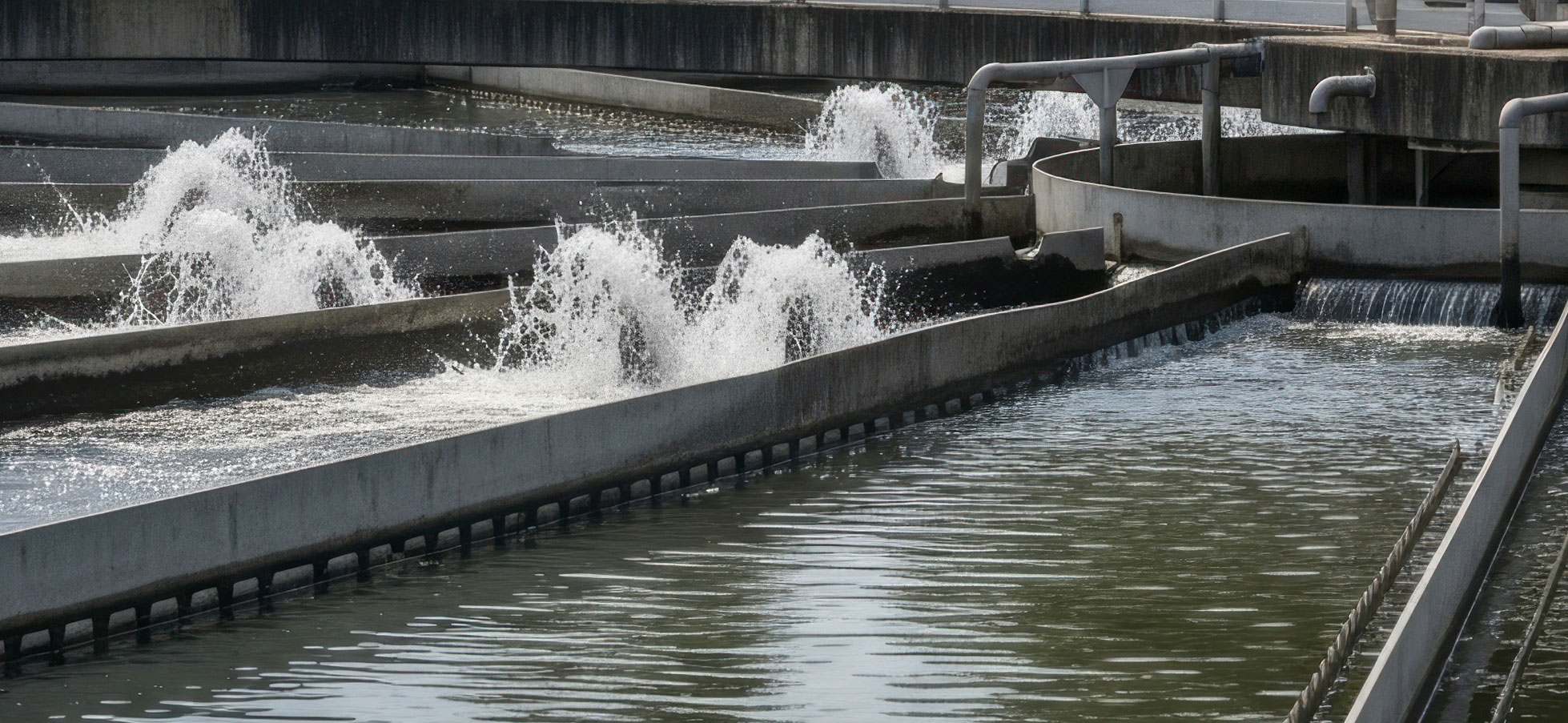
Dissolved Air Flotation (DAF)
Hydroxy designs and integrates Dissolved Air Flotation systems that combine chemical conditioning with fine-bubble flotation to separate suspended and lightweight contaminants from wastewater—delivering efficient clarification, reduced pollutant loading and dependable downstream treatment performance.
Dissolved Air Flotation Technology
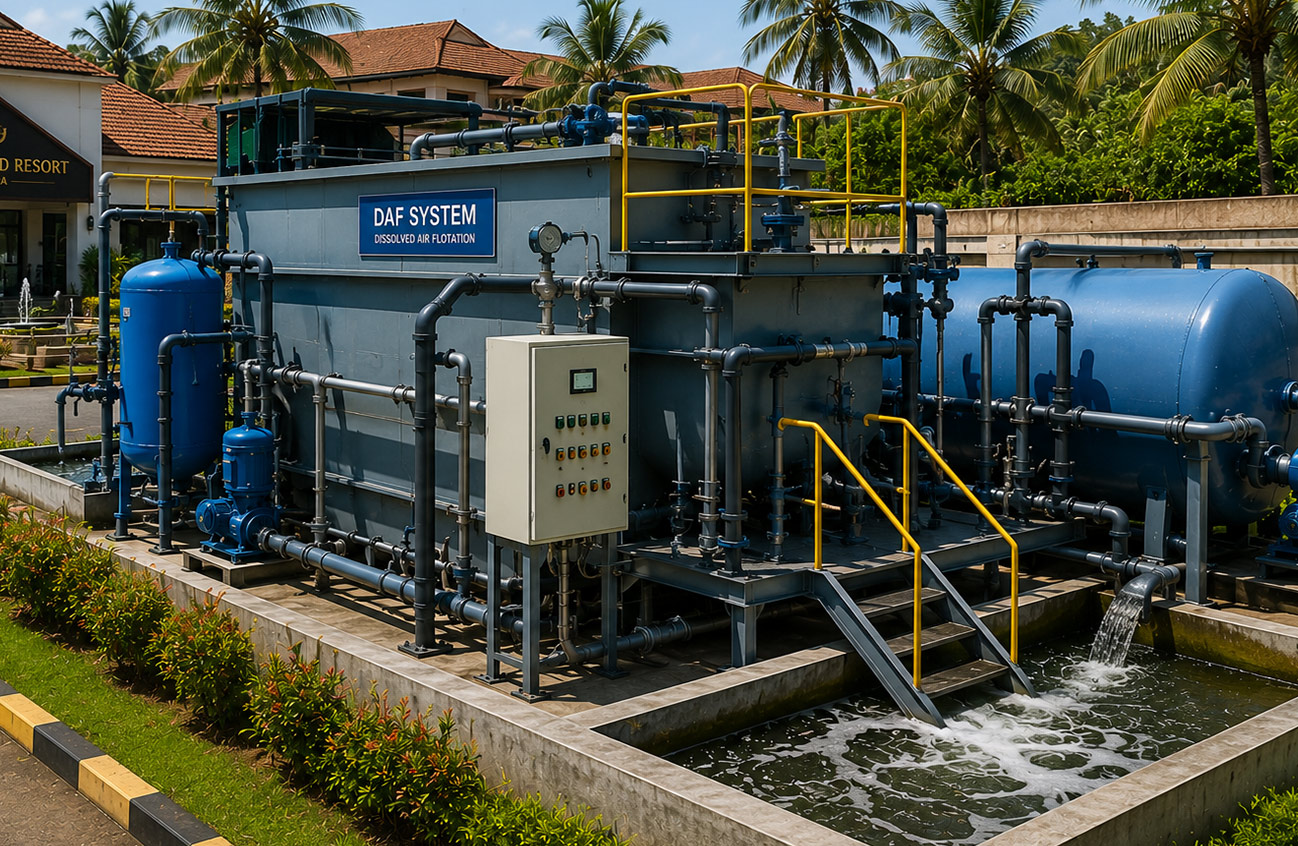
Dissolved Air Flotation is a physical and chemical separation process designed to remove contaminants that are difficult to separate efficiently through gravity settling alone.
The process uses fine air bubbles that attach to suspended particles, fats, oils, grease and other floatable contaminants within the wastewater. As the bubbles attach to these contaminants, their effective density decreases and they rise to the surface of the flotation tank, forming a concentrated floating sludge layer.
A mechanical skimming system continuously or periodically removes this floated material, while clarified water leaves the DAF unit for discharge, reuse or further treatment. Where required, coagulation and flocculation are incorporated upstream of the flotation chamber to combine fine particles into larger, more easily separable flocs.
Hydroxy Water Technologies designs DAF systems around wastewater characteristics, contaminant loading, hydraulic flow, chemical-treatment requirements, recycle ratio and required clarified-water quality.
The result is a compact separation process engineered for efficient contaminant removal, stable operation and dependable downstream performance.

The DAF Principle
Attach microscopic air bubbles to contaminants and lift them to the surface for removal.
Incoming wastewater is evaluated and, where required, chemically conditioned to improve contaminant separation.
A suitable coagulant can be added to destabilise fine suspended and colloidal particles.
Gentle mixing encourages destabilised particles to combine into larger flocs that are more effectively captured by air bubbles.
A mechanical scraper removes the accumulated floated sludge from the surface into a sludge collection system.
Clarified water leaves the DAF unit and proceeds to its next treatment stage or intended application. Condition → Flocculate → Saturate → Float → Skim → Clarify.
Engineered Around Your Contaminant Load - DAF Performance Depends on More Than Flow Capacity
Selecting a DAF unit simply by cubic metres per hour does not ensure effective separation. Performance depends on understanding what needs to float, how much of it is present and how effectively those contaminants interact with chemical flocs and air bubbles.
Hydroxy evaluates important parameters such as:
- Average Wastewater Flow
- Peak Hydraulic Flow
- Total Suspended Solids — TSS
- Fats, Oils & Grease — FOG
- COD — Chemical Oxygen Demand
- BOD, where relevant
- pH, Turbidity
- Particle Characteristics
- Oil Concentration
- Chemical Conditioning Requirement
- Coagulant Demand & Flocculant Demand
- Hydraulic Loading
- Required Clarified-Water Quality
- Sludge Production
Based on these parameters, Hydroxy determines the appropriate:
- DAF Tank Capacity
- Hydraulic Loading Rate
- Chemical Dosing Strategy
- Mixing Conditions
- Flocculation Requirements
- Air Saturation System
- Recycle Flow
- Sludge Skimming Arrangement
- Instrumentation & Automation
*The objective is not simply to install a flotation tank—it is to engineer the right combination of chemistry, hydraulics and air-to-solids interaction.
SBR Treatment Cycle
Carrier media is central to MBBR performance. Each carrier provides protected internal surface area where microorganisms can attach and develop into biofilm while remaining exposed to wastewater and dissolved oxygen.
An effective carrier-media system must consider:
- Protected Surface Area
- Media Geometry
- Media Density
- Fill Percentage
- Biofilm Accessibility
- Hydraulic Movement
- Oxygen Transfer
- Media Retention
- Long-Term Mechanical Stability
Hydroxy selects and sizes carrier media according to the biological load and treatment objective, ensuring that sufficient active surface area is available within the reactor.
Chemical Conditioning
Many wastewater contaminants are too small, too stable or too finely dispersed to separate efficiently without chemical conditioning. DAF performance can therefore depend heavily on what happens before wastewater reaches the flotation zone. Hydroxy can engineer an appropriate chemical-treatment sequence incorporate.
Wastewater pH can be adjusted where necessary to create suitable conditions for coagulation and contaminant removal.
Coagulants destabilise fine suspended and colloidal particles that would otherwise remain dispersed in the wastewater.
Flocculants help smaller destabilised particles combine into larger aggregates.
Rapid and slow mixing stages can be engineered to provide sufficient chemical dispersion and floc formation without damaging the resulting flocs.
Chemical dosage can be adjusted according to actual wastewater characteristics and required separation performance.
Air Saturation & Microbubble Generation
The air-saturation system is at the heart of Dissolved Air Flotation. A controlled portion of clarified water is typically recycled and brought into contact with compressed air under pressure. Under these conditions, air dissolves into the water. When the pressurised stream is released into the flotation chamber at lower pressure, the dissolved air forms a cloud of very fine bubbles.
These microbubbles attach to suspended contaminants and provide the buoyancy required to carry them toward the surface. Hydroxy engineers the air-saturation and recycle system around:
- DAF Hydraulic Capacity
- Recycle Flow
- Operating Pressure
- Air Delivery
- Saturation Efficiency
- Contaminant Loading
- Required Flotation Performance
*The objective is to create stable and uniform microbubble distribution across the flotation zone.
DAF Treatment Process - From Contaminated Wastewater to Clarified Water
A Hydroxy DAF system integrates chemical treatment, air saturation, hydraulic separation and sludge handling as one coordinated process.
Where incoming flow or contaminant concentrations fluctuate significantly, equalisation can provide a more stable feed to the DAF process.
Wastewater chemistry is adjusted where required to support effective coagulation and flotation.
Chemical conditioning destabilises fine suspended and colloidal contaminants.
Particles combine into larger flocs suitable for efficient bubble attachment and flotation.
Clarified recycle water is saturated with compressed air under controlled pressure.
The pressurised stream enters the flotation zone, releasing fine air bubbles.
Bubbles attach to contaminants and carry them upward toward the surface.
A mechanical skimmer removes the concentrated floating sludge into the sludge collection system.
Clarified water is collected from below the flotation zone and directed to the next treatment stage or intended application.
SBR Automation & Process Control - The Right Process at the Right Time
Automation is fundamental to reliable SBR operation because each treatment stage must happen in the correct sequence and for the appropriate duration.
Hydroxy can integrate PLC-based control of:
- Inlet Pumps
- Feed Valves
- Reactor Levels
- Mixers
- Aeration Blowers
- Air Control Valves
- Dissolved Oxygen
- Settling Periods
- Decanter Operation
- Sludge Wasting
- Chemical Dosing, where required
- Cycle Timing
- High / Low Level Conditions
- Equipment Faults
- Alarm Conditions
The control system coordinates the complete: Fill → React → Settle → Decant → Idle sequence with minimal routine operator intervention. This provides greater consistency between treatment cycles and gives operators clearer visibility into system status.
Aeration & Biological Control - Delivering the Oxygen the Biology Actually Needs
Aeration is one of the most important energy-consuming and process-critical components of an SBR. Too little oxygen can limit biological treatment.
Excessive aeration can waste energy without providing proportional improvement in treatment performance.
Hydroxy considers:
- Incoming Organic Load
- Oxygen Demand
- Reactor Depth
- Diffuser Arrangement
- Oxygen Transfer Efficiency
- Required Dissolved Oxygen
- Mixing Requirements
- Blower Turndown
- Aerated Cycle Duration
The objective is to provide the required biological oxygen transfer while avoiding unnecessary aeration energy.
SBR Decanting System - Removing Treated Water Without Disturbing the Biology
The decant stage is a defining part of the SBR process. After biological solids settle, treated water must be withdrawn from the clarified upper zone while avoiding excessive turbulence or solids carryover.
Where incoming flow or contaminant concentrations fluctuate significantly, equalisation can provide a more stable feed to the DAF process.
Wastewater chemistry is adjusted where required to support effective coagulation and flotation.
Chemical conditioning destabilises fine suspended and colloidal contaminants.
Particles combine into larger flocs suitable for efficient bubble attachment and flotation.
Clarified recycle water is saturated with compressed air under controlled pressure.
The pressurised stream enters the flotation zone, releasing fine air bubbles.
Bubbles attach to contaminants and carry them upward toward the surface.
A mechanical skimmer removes the concentrated floating sludge into the sludge collection system.
Clarified water is collected from below the flotation zone and directed to the next treatment stage or intended application.
Designed for Difficult-to-Settle Contaminants - When Gravity Is Not Enough
Conventional sedimentation depends on contaminants being sufficiently dense to settle. Many industrial wastewater contaminants behave differently. Fats, oils, grease, low-density particles and fine suspended solids may remain dispersed or float naturally instead of settling efficiently.
DAF reverses the separation approach. Rather than trying to force these contaminants downward, the system intentionally carries them upward using fine air bubbles.
This makes DAF particularly valuable where wastewater contains:
- Fats, Oils & Grease
- Suspended Solids
- Fine Particles
- Floating Solids
- Colloidal Material
- Food Solids
- Fibres
- Process Residues
- Chemically Precipitated Solids
- Insoluble Organic Material
Industrial DAF Applications - Separation Engineered Around the Process
DAF technology can be applied where wastewater contains substantial suspended or floatable contaminant loads.
Removal of fats, grease, proteins and suspended food solids from process wastewater.
Separation of fats and suspended organic material from dairy wastewater streams.
Removal of fats, oils, grease and process solids before further treatment.
Treatment of suspended solids, lint, oils and other wastewater contaminants.
Removal of suspended solids and process-related contaminants before downstream treatment.
Separation of fibres and other floatable or suspended solids from process wastewater.
*Final DAF configuration is determined by actual wastewater characterisation rather than industry category alone.
How It Works?!
Hydroxy follows a structured engineering approach to balance wastewater chemistry, bubble generation and hydraulic separation.
We evaluate flow, TSS, oil and grease, COD, pH, temperature and other relevant characteristics.
The nature of suspended and floatable contaminants is evaluated to determine how effectively they can be separated through DAF.
Where required, suitable coagulation, flocculation and pH-adjustment strategies are developed.
Tank geometry, loading conditions and wastewater distribution are engineered to provide effective flotation and clarified-water separation.
Recycle rate, saturation pressure and air delivery are designed to create the required microbubble conditions.
Surface skimming and sludge-removal arrangements are selected according to anticipated floated-solids production.
Pumps, chemical dosing, levels, pressure, recycle flow and skimmer operation can be integrated with automated controls.
The system is commissioned while chemical dosing, recycle conditions, pressures and skimming rates are progressively optimised.
Hydroxy commissions the system progressively while establishing biomass and optimising the biological and hydraulic operating cycle.
Actual operating data is used to refine chemical consumption, flotation efficiency and sludge removal.
DAF Automation & Process Control - Keep Chemistry, Air and Hydraulics Working Together
Reliable DAF performance depends on maintaining stable interaction between several operating variables.
Hydroxy can integrate control and monitoring for:
- Feed Pumps
- pH
- Wastewater Flow
- Chemical Dosing
- Coagulant Dosing
- Flocculant Dosing
- Recycle Pumps
- Saturation Pressure
- Air Supply
- Tank Levels
- Surface Skimmer
- Sludge Pumps
- Equipment Status
- Alarm Conditions
PLC-based automation can coordinate these components while providing operators with visibility into system status and performance.
DAF Sludge Management - Separation Is Only Complete When the Float Is Removed
DAF concentrates contaminants into a floating sludge layer. The characteristics and quantity of this sludge depend on incoming solids, oils, chemical dosage and flotation performance. Hydroxy considers sludge handling as part of the complete DAF system design.
Depending on the application, this may include:
- Surface Sludge Skimming
- Sludge Collection Hopper
- Sludge Holding Tank
- Sludge Transfer Pumps
- Sludge Thickening
- Dewatering Integration
- Filter Press Integration
Effective sludge management helps prevent accumulated floated solids from interfering with stable DAF operation.
DAF Retrofit & Performance Optimisation - Existing DAF Not Delivering the Required Performance?
A DAF system can underperform even when the flotation tank itself is mechanically sound.
Typical problems may include:
- Poor TSS Removal
- High Oil & Grease in Clarified Water
- Weak Floc Formation
- Excessive Chemical Consumption
- Poor Microbubble Generation
- Uneven Flow Distribution
- Insufficient Recycle Pressure
- Sludge Carryover
- Ineffective Surface Skimming
- Excessive Sludge Production
- Hydraulic Overloading
- Automation Problems
Hydroxy can evaluate the complete DAF process to identify whether the limitation originates from water chemistry, chemical dosing, hydraulics, saturation, flotation or sludge removal.
Optimisation May Include:
- Chemical-Dose Optimisation
- pH-Control Improvements
- Coagulation / Flocculation Improvements
- Saturation-System Upgradation
- Recycle-Pump Optimisation
- Hydraulic Improvements
- Skimmer Upgradation
- Capacity Enhancement
- Instrumentation Addition
- PLC & Automation Upgradation
Improving DAF performance often requires optimising the complete separation process not simply replacing the flotation unit.
Why Hydroxy? - DAF Is Chemistry + Air + Hydraulics
Successful Dissolved Air Flotation depends on much more than generating bubbles. The system must create the correct relationship between: Poor coagulation can prevent particles from forming suitable flocs, Incorrect air saturation can reduce bubble availability, Poor hydraulic distribution can create short-circuiting, and Inadequate skimming can allow accumulated solids to interfere with clarified-water quality.
Hydroxy approaches DAF as an integrated physical-chemical separation system, combining:
- Wastewater Characterisation
- Chemical Treatment Engineering
- Coagulation & Flocculation
- Hydraulic Design
- Air-Saturation Engineering
- Microbubble Generation
- Sludge Removal
- Instrumentation
- Automation
- Commissioning
- Process Optimisation
Our engineering approach begins with one essential question: "What needs to float and what conditions are required to separate it efficiently?"
Key Benifits
DAF provides an efficient physical separation mechanism for suspended and lightweight particles that may be difficult to remove through gravity settling alone.
Fine-bubble flotation is particularly suited to separating fats, oils, grease and other low-density contaminants from wastewater.
Removing suspended and floatable contaminants early in the treatment process can reduce the load placed on downstream treatment equipment.
DAF can provide high-rate solid-liquid separation within a relatively compact footprint compared with many conventional gravity-based separation approaches.
PLC-based automation can coordinate filling, aeration, settling, decanting and sludge management with reduced routine operator intervention.
Coagulation, flocculation and pH adjustment can be engineered as part of the complete DAF process to improve contaminant separation.
Flotation concentrates separated contaminants at the surface, allowing them to be mechanically removed and transferred to sludge handling.
Chemical dosing, recycle pumps, saturation pressure, skimming and sludge removal can be integrated with PLC-based controls.
Existing DAF systems can be evaluated and optimised through improvements to chemistry, recycle conditions, hydraulics, air saturation, skimming and automation.