Grey Water Recycling
Hydroxy designs Grey Water Recycling systems that collect, treat and recover water from showers, wash basins, laundry and other suitable sources—creating a dependable supply for appropriate non-potable reuse applications.
Grey Water Recycling
A significant portion of water used in buildings comes from showers, hand wash basins, baths and laundry. Instead of allowing this relatively low-contamination wastewater to leave the property after a single use, it can be collected separately, treated and reused for suitable non-potable applications.
Hydroxy Water Technologies designs Grey Water Recycling systems around the source, daily volume, water characteristics and intended reuse requirement.
The treatment process can combine filtration, biological or membrane treatment where appropriate, disinfection and treated-water storage to provide a reliable recycled-water supply.
The objective is simple: use water more than once wherever it is technically and practically appropriate.

Grey Water Treatment Principle
Grey water treatment is based on the principle of collecting relatively low-contamination wastewater separately, removing physical and organic contaminants, disinfecting the treated water, and recovering it for suitable non-potable reuse.
Grey water from showers, wash basins, baths and suitable laundry sources is collected separately from toilet wastewater.
Hair, lint, fibres and larger suspended materials are removed.
Incoming water is balanced to manage variations in flow and contaminant concentration.
Biodegradable soaps, organic matter and other dissolved contaminants are reduced where required.
Suspended solids and turbidity are removed using appropriate filtration or membrane technology.
Chlorination or another suitable disinfection process is used to control microorganisms.
Treated water is stored separately and reused for suitable applications such as toilet flushing, landscaping, gardening and floor washing.
Capture water after its first use, treat it to the required quality, and safely use it again. Grey Water Collection → Screening → Equalisation → Biological Treatment → Filtration → Disinfection → Treated Water Storage → Reuse
Where Grey Water Comes From - Recover Water Before It Becomes Waste
Grey water is collected separately from toilet waste and other wastewater streams that require different treatment approaches. Proper source segregation is therefore an important part of an effective grey water recycling system.
Typical grey water sources can include:
- Showers & Baths
- Hand Wash Basins
- Laundry / Washing Machines
- Selected Utility Wash Water
- Other Suitable Low-Contamination Sources
Where Recycled Grey Water Can Be Used - Turn Used Water Into a Reusable Resource
Reusing treated grey water for suitable applications can help reduce the amount of freshwater used for activities that do not require drinking-water quality.
Depending on treatment quality, system design and applicable requirements, treated grey water may be reused for:
- Toilet Flushing
- Landscape Irrigation
- Gardening
- Floor Washing
- External Area Cleaning
- Selected Utility Applications
Engineered Around Your Water Balance - Match the Water You Generate With the Water You Can Reuse
An effective grey water system begins by understanding two things: How much grey water is available? and How much recycled water can the facility actually use?
Hydroxy evaluates:
- Daily Grey Water Generation
- Peak & Average Flow
- Grey Water Sources
- Suspended Solids
- Organic Load
- pH, Turbidity
- Required Treated-Water Quality
- Daily Reuse Demand
- Available Installation Space
- Storage Requirements
Treatment Process
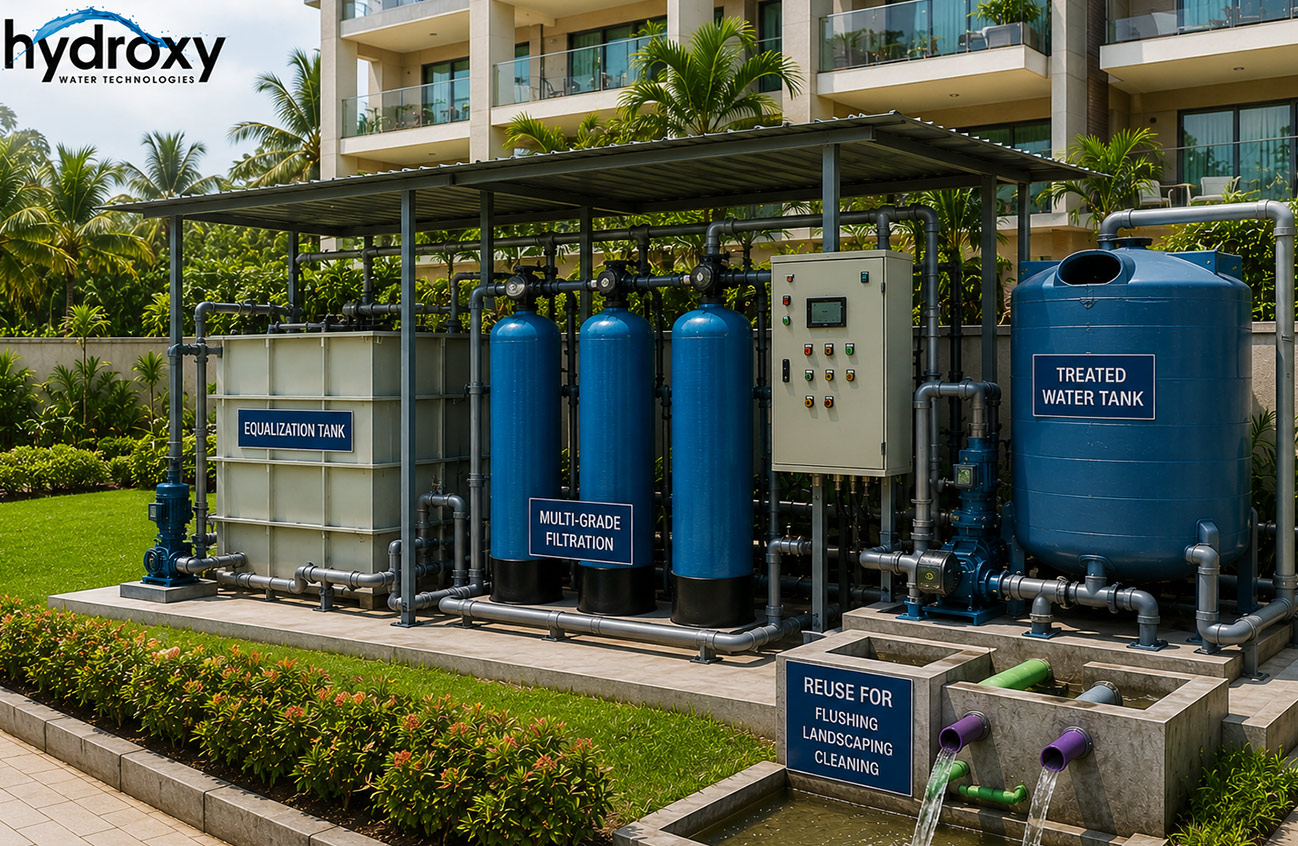
Depending on source-water characteristics and reuse requirements, a Hydroxy system may incorporate.
Grey water is collected separately and larger debris is removed before treatment.
Incoming flow is balanced to provide more stable conditions for the treatment process.
Appropriate treatment is selected to reduce suspended matter, turbidity and organic contaminants.
Where higher treated-water quality is required, fine filtration or membrane technologies can be incorporated.
An appropriate disinfection stage can be included according to the intended reuse application.
Recycled water is stored separately before being distributed to the designated reuse points.
Why Hydroxy?
Grey Water Recycling Is a Water-Balance Solution. Installing treatment equipment alone does not guarantee an effective recycling system. The system needs to connect grey water generation, treatment capacity, storage and actual reuse demand as one integrated process.
An oversized system can add unnecessary cost, while an undersized system may fail to capture the available reuse opportunity. Hydroxy combines water assessment, treatment engineering, filtration, automation and practical site integration to develop grey water recycling systems around real building usage.
Our approach starts with one important question: "How much of your used water can become useful water again?"
Key Benifits
Recycled grey water can replace freshwater for suitable non-potable applications, helping reduce overall freshwater demand.
Recovering and reusing suitable grey water reduces the volume of water leaving the facility after a single use.
Grey water recycling creates a more circular approach to water use by keeping suitable water within the facility for additional applications.
Hydroxy sizes the system according to grey water availability, treatment requirements and actual reuse demand rather than simply specifying a standard-capacity plant.
Treatment, storage, pumping and recycled-water distribution can be integrated as one coordinated solution.