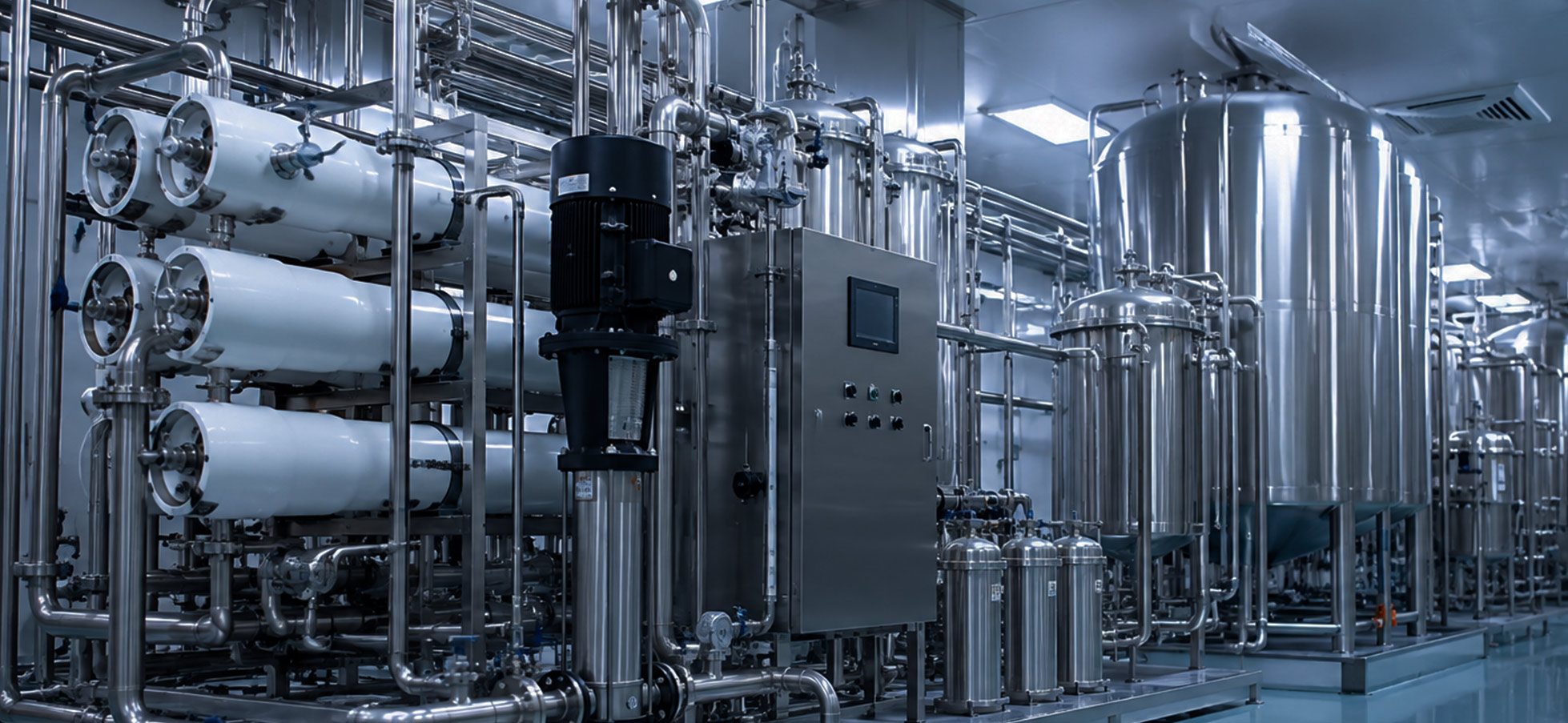
Pharmaceutical Water Systems
High-purity water engineered for pharmaceutical manufacturing. Hydroxy designs integrated Pharmaceutical Water Systems for reliable generation, storage and distribution of high-purity process water—engineered around feed-water quality, required water grade, capacity, hygienic design and operational control.
Pharmaceutical Water Systems
Water used in pharmaceutical manufacturing requires more than conventional purification. The complete system must consistently generate the required water quality while controlling chemical impurities, ionic contaminants, microorganisms and contamination risks throughout storage and distribution.
Hydroxy Water Technologies designs Pharmaceutical Water Systems around the complete water lifecycle: Generation → Purification → Storage → Distribution → Monitoring → Sanitisation
Depending on the required water quality and application, the treatment system can integrate membrane purification, ionic polishing, sanitary storage, recirculating distribution and automated process monitoring. The objective is to deliver consistent high-purity water from the generation system through to the point of use.

Pharmaceutical Water Treatment Principle
A pharmaceutical water system is designed not only to produce high-quality water, but also to maintain that quality throughout the complete system.
Incoming water is conditioned to protect downstream purification equipment and maintain stable operation.
Reverse Osmosis removes a major portion of dissolved salts and other feed-water contaminants.
Where required, additional purification such as EDI or other appropriate polishing processes is incorporated to achieve the specified water quality.
Purified water is stored in a suitably engineered sanitary storage system designed to minimise contamination risk.
Water is continuously or appropriately circulated through a sanitary distribution loop to maintain controlled conditions throughout the system.
Critical water-quality and operating parameters are monitored, while appropriate sanitisation strategies are incorporated to maintain system hygiene. Feed Water → Pre-Treatment → Purification → Polishing → Sanitary Storage → Distribution Loop → Point of Use
Engineered Around Your Required Water Grade - Start With the Final Water Specification
Pharmaceutical water systems should not be selected simply by plant capacity. Hydroxy evaluates parameters including:
- Feed-Water Quality
- Required Product-Water Quality
- Required Flow & Daily Capacity
- Conductivity
- Total Organic Carbon, where applicable
- Microbiological Control Requirements
- Feed-Water Hardness & TDS
- Silica, where relevant
- Storage Volume
- Peak Point-of-Use Demand
- Distribution Loop Length
- Recirculation Requirement
- Sanitisation Strategy
- Monitoring & Automation Requirements
These parameters determine the appropriate purification process, system configuration, storage capacity and distribution-loop design.
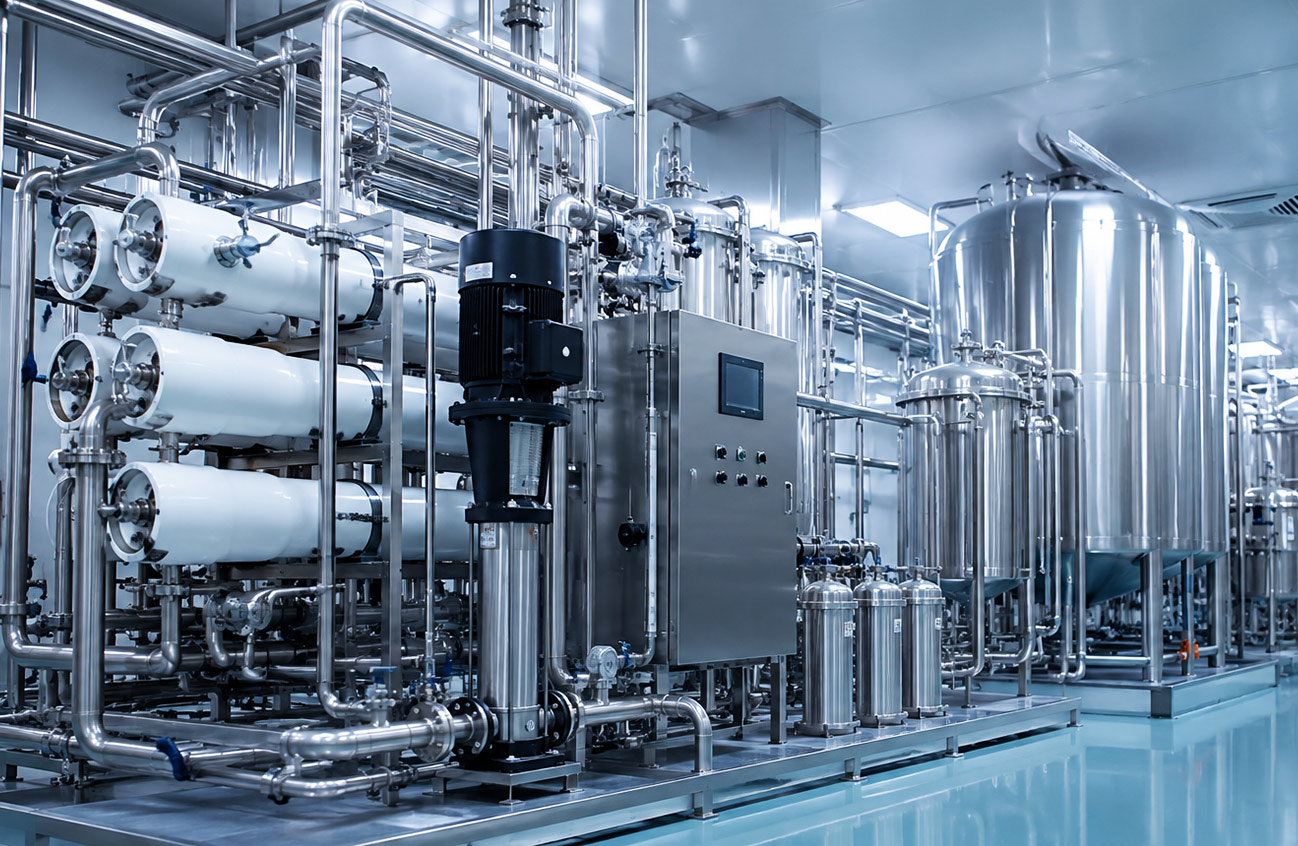
Typical System Configuration
Depending on the required pharmaceutical water specification, a Hydroxy system may incorporate:
- Feed-Water Pre-Treatment
- Multimedia / Appropriate Pre-Filtration
- Activated Carbon Treatment, where applicable
- Water Softening, where required
- Micron Filtration
- Reverse Osmosis
- Double-Pass RO, where required
- Electrodeionization — EDI
- UV Treatment, where required
- Final Polishing
- Sanitary Storage Tank
- Recirculation Pumps
- Sanitary Distribution Loop
- Conductivity Monitoring
- TOC Monitoring, where required
- Temperature Monitoring
- Flow & Pressure Instrumentation
- PLC / HMI Automation
The final configuration is selected according to the required water quality and pharmaceutical application.
Purified Water Generation - Reliable High-Purity Water Production
Hydroxy designs Purified Water generation systems around the feed-water chemistry and required product-water quality.
Pre-Treatment → Reverse Osmosis → Second-Pass RO / EDI → Final Conditioning → Purified Water Storage The exact sequence is determined by the incoming water quality and required system performance.
The objective is consistent product-water quality with reliable operation and controlled downstream contamination risk.
Sanitary Storage & Distribution - Maintaining Purity After Treatment
Producing high-purity water is only one part of the system. Once purified, the water must be stored and distributed without compromising the quality achieved during treatment. Hydroxy considers:
- Hygienic Tank Design
- Appropriate Wetted Materials
- Sanitary Piping
- Recirculating Distribution
- Drainability
- Minimisation of Dead Legs
- Appropriate Flow Conditions
- Vent-Filtration Requirements
- Point-of-Use Configuration
- Sanitisation Requirements
High-purity water must remain high-purity water until it reaches the point of use.
Typical Applications
Hydroxy Iron Removal Systems can be used for:
- Borewell Water
- Groundwater
- Residential Water Supply
- Apartments & Villas
- Hotels & Resorts
- Hospitals & Institutions
- Commercial Buildings
- Industrial Utility Water
- Process-Water Pre-Treatment
Sanitisation & Microbial Control - Designed to Maintain System Hygiene
Microbial control is a critical consideration in pharmaceutical water systems. Depending on the process requirements, the system can incorporate appropriate approaches for:
- Hot-Water Sanitisation
- Chemical Sanitisation
- UV Treatment
- Controlled Recirculation
- Sanitary Tank Management
- Loop Sanitisation
- Microbiological Sampling Points
The sanitisation strategy is developed around the system configuration and operational requirements.
Monitoring & Automation - Make Water Quality Visible
Hydroxy Pharmaceutical Water Systems can integrate instrumentation and automated controls for critical parameters such as:
- Conductivity
- Flow
- Pressure
- Temperature
- Tank Level
- RO Performance
- EDI Performance
- Recirculation Status
- TOC, where required
- System Alarms
- Sanitisation Cycles
PLC / HMI-based control provides operators with clearer visibility into system status and supports consistent operating sequences.
How It Works? - From Feed Water to Controlled High-Purity Water
Incoming water chemistry and variability are evaluated.
The required pharmaceutical water specification, capacity and point-of-use demand are defined.
The appropriate purification, polishing, storage and distribution configuration is developed.
Storage, piping, circulation, instrumentation and points of use are designed as one integrated high-purity system.
Equipment is installed, tested and commissioned against defined operating parameters.
Hydroxy supports preventive maintenance, membrane and purification-system servicing, sanitisation support and performance optimisation.
Why Hydroxy? - Pharmaceutical Water Is a Complete System
High-purity water generation cannot be treated as an isolated RO or polishing unit.
Reliable performance depends on the relationship between: Feed-Water Quality + Purification + Hygienic Storage + Distribution + Sanitisation + Monitoring
A well-designed generation system can still fail to maintain water quality if storage and distribution are poorly engineered.
Hydroxy therefore approaches Pharmaceutical Water Systems as an integrated high-purity water solution—from incoming feed water to the final point of use.
Our engineering approach begins with one essential question: "What water quality must be maintained at the point of use?"
Key Benifits
Integrated purification and polishing processes are engineered around the required pharmaceutical water specification.
Storage and distribution are designed to help maintain the quality produced by the purification system.
Recirculation, sanitisation and appropriate hygienic design help support microbial control throughout the system.
Instrumentation and automation provide clearer visibility into critical water-quality and operating parameters.
System capacity and configuration are developed according to water specification, production demand, feed-water quality and facility requirements.
Producing high-purity water at the treatment skid is only the first step. The real engineering objective is to preserve that quality through storage, circulation and delivery to every required point of use. Purify → Protect → Circulate → Monitor