
Pressure Sand Filters
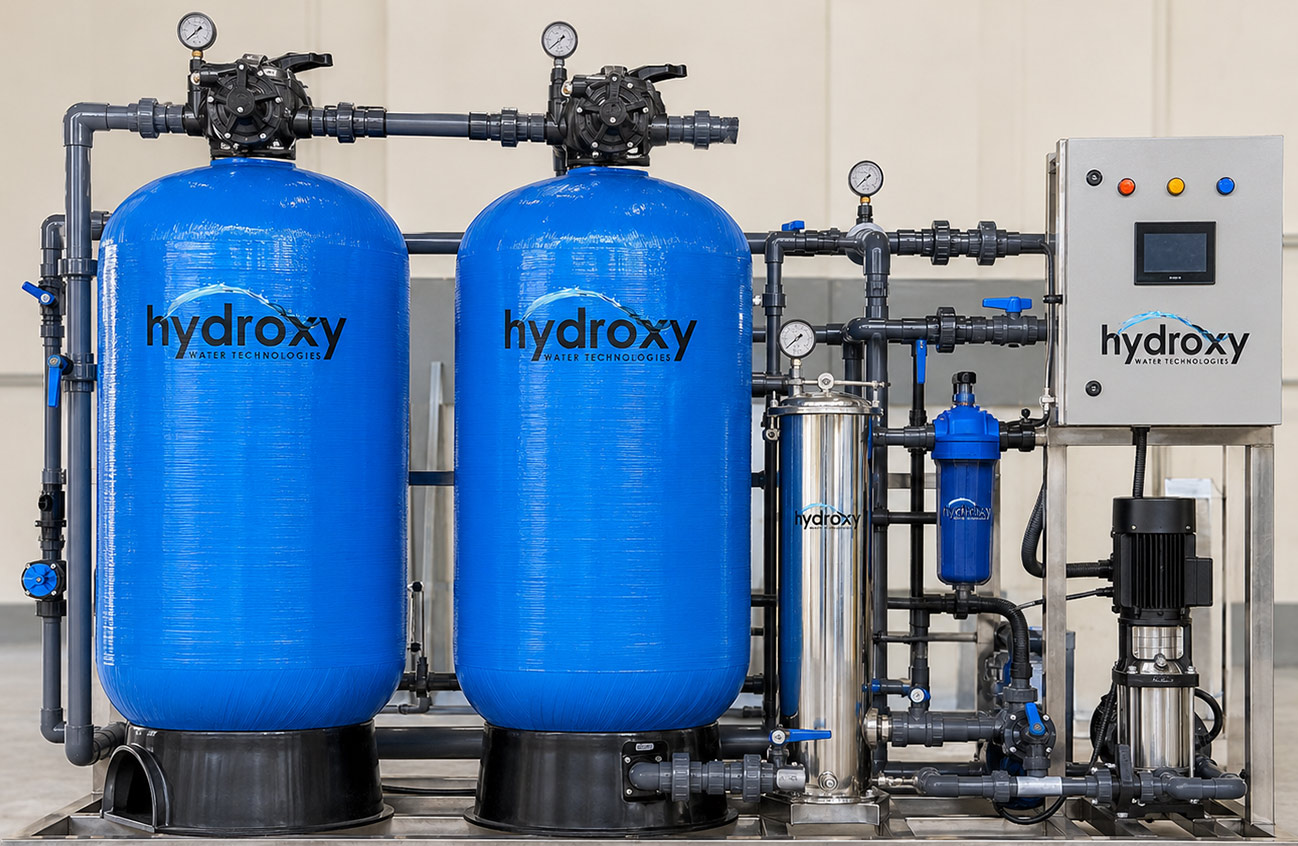
Hydroxy designs Pressure Sand Filters for efficient removal of suspended particles and turbidity—providing dependable filtration for water treatment, process applications and downstream equipment protection.
Pressure Sand Filters
Pressure Sand Filtration is a proven physical water-treatment process used to reduce suspended solids, sediment and turbidity from incoming water. Water is passed under pressure through a carefully selected bed of graded filtration media. Suspended contaminants are retained within the media bed while filtered water passes through for use or further treatment.
Hydroxy Water Technologies designs Pressure Sand Filters according to incoming water quality, required flow rate, solids loading, filtration velocity and application requirements. The result is a simple, robust and dependable filtration system designed to improve water clarity and protect downstream treatment equipment.

Pressure Sand Filtration Principle
Pressure Sand Filters operate on the principle of physical depth filtration. As water flows through layers of graded filtration media, suspended particles are captured within the void spaces of the filter bed.
Raw water enters the pressure vessel and passes through the sand media.
Suspended solids, sediment and turbidity-causing particles are retained within the media bed.
Filtered water passes through the bottom collection system and exits the vessel.
As contaminants accumulate, the pressure drop across the filter increases. The filter is periodically backwashed by reversing the water flow to loosen the media and remove trapped solids.
After backwashing, the media is rinsed and the filter is returned to normal service. Filtration → Solids Retention → Backwash → Rinse → Service
Engineered Around Your Filtration Load - The Right Filter Starts With the Right Flow and Water Quality
Pressure Sand Filters should not be selected only by vessel size. Hydroxy evaluates important operating parameters including:
- Inlet Turbidity
- Suspended-Solids Load
- Required Flow Rate
- Filtration Velocity
- Operating Pressure
- Media Bed Depth
- Required Filtered-Water Quality
- Pressure Drop
- Backwash Flow Requirement
- Operating Hours
Tertiary Treatment Technologies
Reduces residual suspended solids and turbidity.
Provides additional polishing for colour, odour and selected organic contaminants.
Provides finer particle removal and protects downstream treatment equipment.
Provides membrane-based removal of fine suspended particles, colloidal matter and microorganisms.
Where significant dissolved-solids reduction is required, RO can be incorporated as an advanced treatment stage.
UV or controlled chemical disinfection can be incorporated to support final microbiological water quality.
These parameters determine the appropriate vessel size, media configuration, hydraulic loading and backwash requirements. The objective is to provide effective filtration while maintaining reliable flow and manageable operating pressure.
Typical Applications
- Raw Water Filtration
- Borewell Water Filtration
- Surface Water Pre-Filtration
- Commercial Water Treatment
- Industrial Process Water
- Cooling-Water Filtration
- Utility Water Treatment
- Pre-Treatment for Downstream Water Systems
How It Works - From Turbid Water to Clearer Filtered Water
Incoming water quality, turbidity, solids loading and required flow are evaluated.
Vessel diameter, filtration rate, media depth and hydraulic conditions are selected according to the application.
Water passes through the graded media bed where suspended contaminants are retained.
As solids accumulate, resistance through the media increases and filter pressure differential changes.
The flow direction is reversed at appropriate intervals to expand and clean the filter media.
After rinsing, the filter resumes normal filtration.
Automatic & Manual Operation
Hydroxy Pressure Sand Filters can be configured for different levels of operating control.
Suitable where filter operation and backwashing are managed directly by an operator.
Valves and control sequences can automate filtration, backwashing and rinsing cycles to reduce routine manual intervention. The appropriate configuration depends on plant capacity, operating frequency and automation requirements.
Why Hydroxy? - Good Filtration Begins With Correct Hydraulic Design
A Pressure Sand Filter may appear simple, but its performance depends on the correct relationship between water quality, media selection, filtration velocity, vessel sizing and backwashing. An incorrectly sized filter can result in poor filtration, excessive pressure drop, frequent backwashing or reduced downstream performance.
Hydroxy designs Pressure Sand Filters around actual operating conditions to provide consistent filtration, dependable hydraulic performance and straightforward maintenance.
Our approach begins with one essential question: "What particle load does your water need the filter to handle?"
Key Benifits
Helps remove suspended particulate matter from incoming water.
Reduction of turbidity and suspended particles produces clearer filtered water.
Pre-filtration can reduce particulate loading on pumps, pipelines and downstream treatment equipment.
Pressure Sand Filtration uses a proven filtration principle with straightforward operating and maintenance requirements.
Accumulated contaminants can be removed through periodic backwashing, allowing the media bed to return to filtration service.
Hydroxy sizes the system according to incoming water quality, solids load, required flow and operating conditions rather than applying a standard filter configuration.