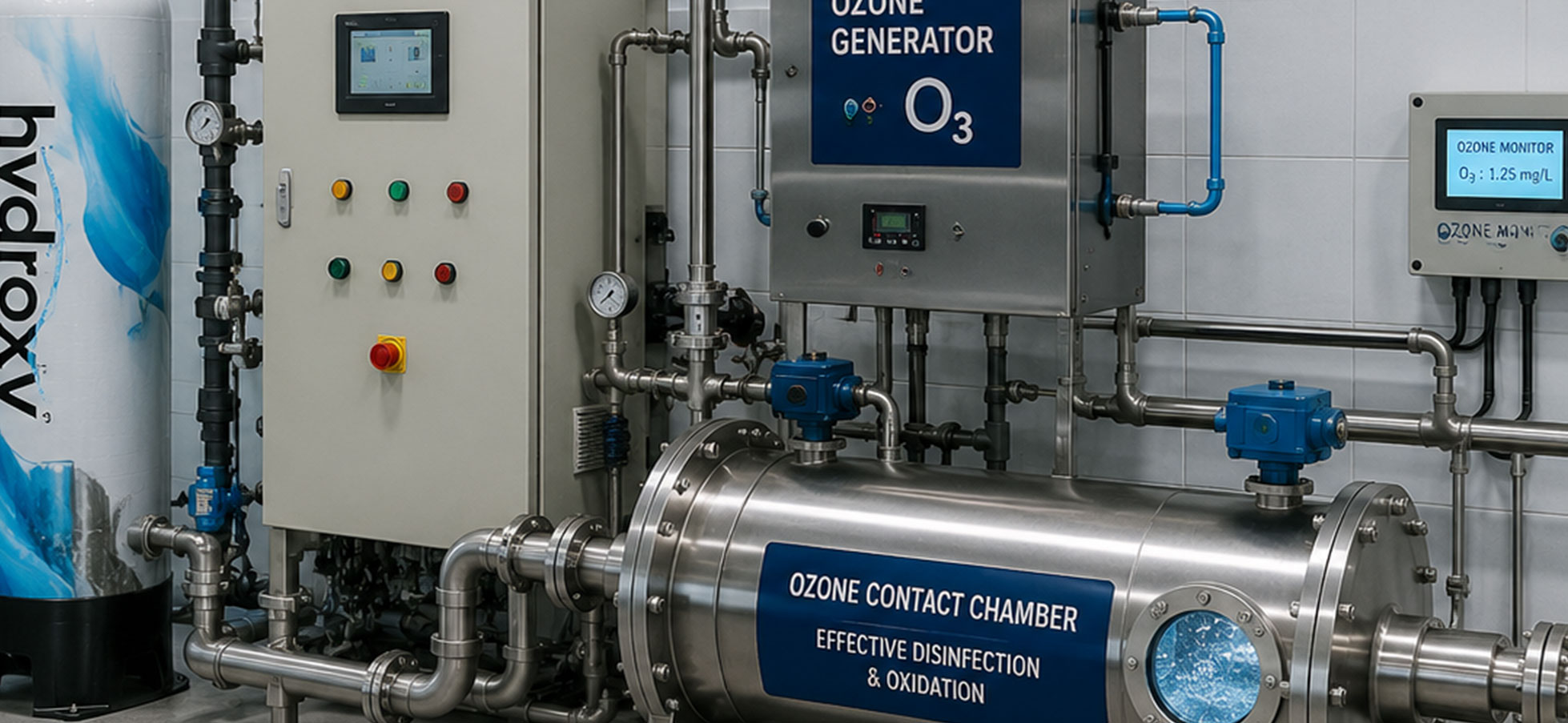
Ozonation
Powerful oxidation and disinfection without continuous chemical addition. Hydroxy designs Ozonation Systems that generate ozone on-site and transfer it efficiently into water for microbial control, oxidation and water-quality improvement across commercial, industrial and process applications.
Ozonation
Ozonation is an advanced water-treatment process that uses ozone (O₃), a powerful oxidising agent, for disinfection and oxidation.
Ozone is generated on-site from air or oxygen and introduced into the water through a controlled gas-transfer system.
Once dissolved, ozone reacts rapidly with microorganisms and selected oxidisable contaminants. After treatment, unused ozone naturally decomposes back to oxygen.
Hydroxy Water Technologies designs Ozonation Systems according to water characteristics, required ozone dose, flow capacity, contact time, transfer efficiency and final treatment objective.

Ozonation Principle
Ozonation works by generating ozone and transferring the required dose into the water.
Ozone is produced on-site, typically using an ozone generator supplied with suitably prepared air or oxygen.
The generated ozone is introduced into the water through an injector, diffuser or other suitable mass-transfer arrangement.
The system is engineered to maximise ozone dissolution and effective contact with the water.
Dissolved ozone reacts with susceptible microorganisms and oxidisable substances.
Water is retained under controlled conditions to provide the required ozone exposure.
Unused ozone is appropriately monitored and managed before discharge. Oxygen / Air → Ozone Generation → Injection → Contact → Oxidation & Disinfection → Treated Water
Engineered Around Ozone Demand - Effective Ozonation Requires the Right Dose and Contact Time
Ozone-system selection should not be based only on generator capacity. The actual ozone requirement depends on how quickly ozone is consumed by substances present in the water. Hydroxy evaluates important parameters such as:
- Required Water Flow
- Ozone Demand
- Required Ozone Dosev
- Contact Time
- pH, Turbidity
- Organic Load
- Iron & Manganese, where relevant
- Water Temperature
- Gas Transfer Efficiency
- Required Disinfection Objective
- Residual Ozone Requirement
- Operating Hours
These parameters determine the appropriate ozone-generation capacity, injection system, contact arrangement and process controls. The objective is to deliver the required ozone exposure—not simply install a larger ozone generator.
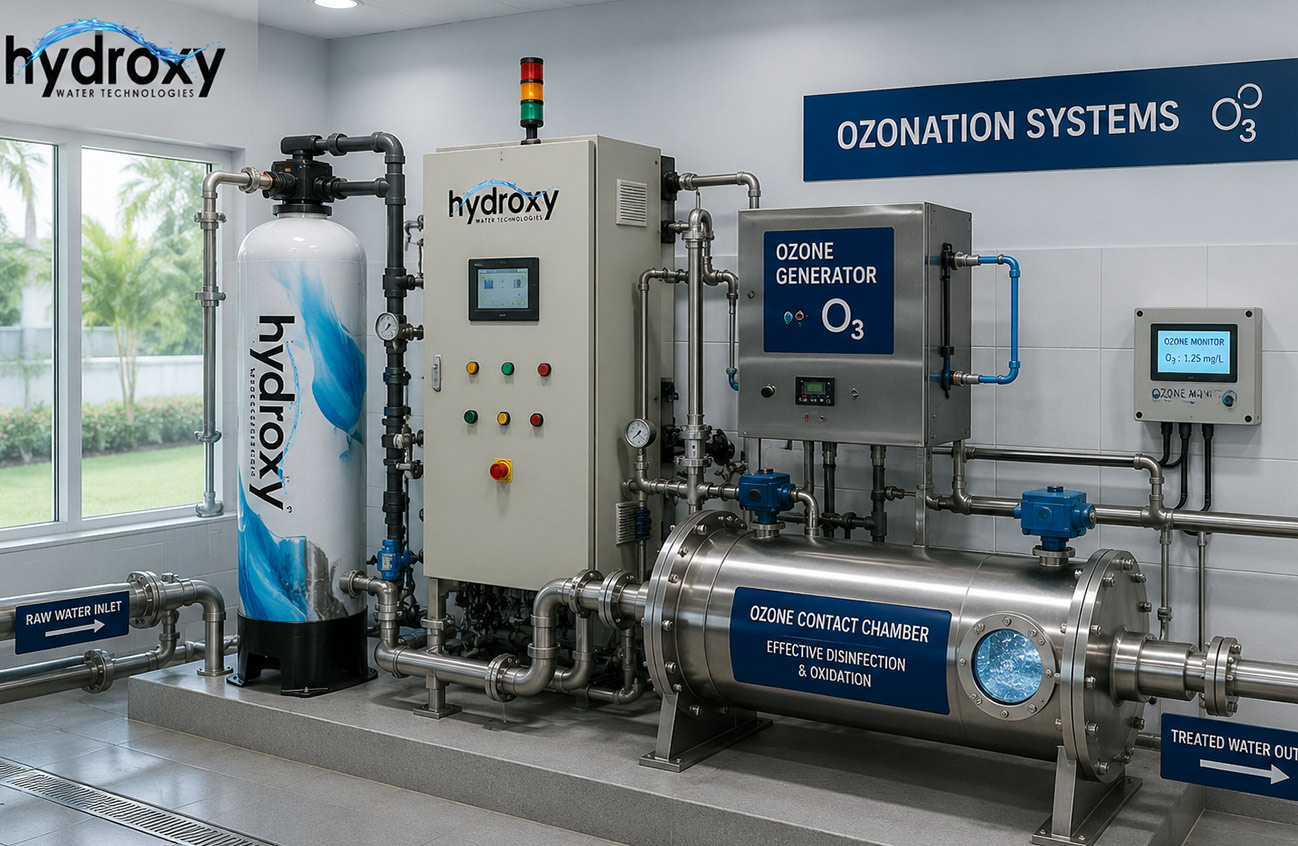
Main Ozonation System Components
Depending on the application, a Hydroxy Ozonation System may incorporate:
- Air / Oxygen Preparation System
- Ozone Generator
- Ozone Injection System
- Venturi Injector or Diffuser
- Contact Tank / Contact Chamber
- Recirculation Pump, where required
- Ozone Residual Monitoring
- Flow Monitoring
- Control Panel / PLC
- Ozone Leak Detector
- Off-Gas Destruction System
- Safety Interlocks
The final configuration is selected according to the treatment capacity and operating requirement.
How It Works - From Feed Water to Ozone-Treated Water
Hydroxy evaluates water quality, flow rate and treatment objective.
The required ozone dose and contact conditions are determined.
Ozone is generated on-site from prepared air or oxygen.
The gas is efficiently dissolved into the water using the selected injection method.
Ozone reacts with microorganisms and oxidisable contaminants.
The water remains under controlled contact conditions while relevant operating parameters are monitored.
Excess ozone is safely handled through appropriate off-gas treatment.
Typical Applications
Hydroxy Ozonation Systems can be used for:
- Drinking Water Treatment
- Bottled Water Applications
- Commercial Water Systems
- Industrial Process Water
- Food & Beverage Water
- High-Purity Water Applications
- Water Storage & Recirculation Systems
- Treated-Water Disinfection
- Selected Water Reuse Applications
Monitoring & Automation
Control Ozone Safely and Consistently Hydroxy can integrate monitoring and automation for:
- Ozone Generator Status
- Ozone Output
- Water Flow
- Contact-Tank Level
- Residual Ozone
- ORP, where appropriate
- Gas Pressure
- Ozone Leak Detection
- Equipment Interlocks
- Alarm Conditions
- Automatic Start / Stop
Automation helps maintain consistent treatment while improving operational visibility and safety.
Ozone Safety - Powerful Treatment Requires Controlled Operation
Ozone is a highly reactive gas and should be generated, transferred and managed within a properly engineered system. Hydroxy considers:
- Controlled Ozone Generation
- Gas-Tight Connections
- Proper Ventilation
- Ozone Leak Detection
- Off-Gas Destruction
- Automatic Safety Interlocks
- Appropriate Materials of Construction
- Safe Maintenance Access
Safe ozone handling is an integral part of the system design—not an optional accessory.
Why Hydroxy? - Ozonation Is About Dose, Transfer and Contact
A high-capacity ozone generator alone does not guarantee effective treatment. Successful ozonation depends on the relationship between: Water Quality + Ozone Demand + Ozone Dose + Transfer Efficiency + Contact Time + Process Control
Poor ozone transfer wastes generated ozone, while insufficient contact can reduce treatment effectiveness.
Hydroxy designs the complete Ozonation System around the actual water characteristics and operating conditions to provide effective ozone utilisation, reliable treatment and controlled operation.
Our approach begins with one essential question: "How much ozone must actually reach the water to achieve the required treatment?"
Key Benifits
Ozone provides strong oxidation and can effectively inactivate susceptible microorganisms when the system is correctly designed and operated.
Ozone is produced at the point of use, reducing the need to store large quantities of a primary disinfectant chemical.
Ozone reacts quickly with many microorganisms and oxidisable contaminants.
After completing its reaction, ozone decomposes naturally, primarily back to oxygen.
Ozonation can assist with selected taste, odour, colour and oxidation-related water-quality issues depending on the contaminants present.
Ozone generation, injection and monitoring can be integrated with automated controls for consistent treatment.
Ozone does not function as a conventional particle filter and is not intended as the primary process for removing: Hardness, TDS, Suspended Sediment, Dissolved Salts
Its purpose is primarily oxidation and microbiological disinfection. Correct treatment depends on understanding what ozone is expected to accomplish in the overall water process.